



Leadership In A Time Of Hunger: Yosef’s Moral Vision In Exile
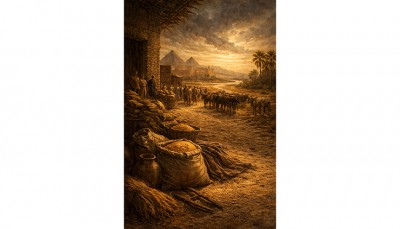
Parashat Vayigash concludes with the famine still gripping Egypt and the surrounding lands. By this point, Yosef is no longer only a savior in moments of crisis—he has become the architect of an entire economic system designed to preserve life with dignity.
In the first year of the famine, Yosef sold grain for money. But money soon disappeared. In the second year, Yosef fed the population in exchange for livestock—horses, donkeys, cattle, and sheep. Eventually, even those resources were exhausted. With nothing left but their bodies and their land, the people came before Yosef and said:
“We will not hide from my L-rd, for insofar as the money and the property in animals have been forfeited to my lord, nothing remains before my L-rd except our bodies and our farmland. Why should we die before your eyes, both we and our farmland? Buy us and our farmland for food… and give us seed, so that we live and not die, and the soil will not lie fallow” (Bereishit 47:18–19).
Yosef agreed—but how he agreed reveals his extraordinary moral stature.
He purchased the people and their land on behalf of Pharaoh, yet immediately provided seed so they could continue to work the land and sustain their families. More remarkably, Yosef instituted a permanent law: only one-fifth of the harvest would belong to Pharaoh. The remaining four-fifths would stay with the farmers—for food, for seed, and for their children.
This was not exploitation. It was preservation.
Yosef ensured that even in servitude, human dignity was protected. The land became state-owned, but the people were not crushed by unbearable taxation. Their labor retained meaning. Their families remained fed. Their future was safeguarded.
It is difficult to find a parallel in ancient history where slaves retained eighty percent of their produce. Even in modern societies, few would protest if total taxation did not exceed twenty percent of income. Yosef’s system was not only efficient—it was compassionate.
Rabbi Zilber notes that this episode invites an unavoidable comparison with the collective farm systems of the twentieth century, particularly in societies that proudly labeled themselves “advanced.” There, too, land was nationalized—but without Yosef’s moral restraint. The result was deprivation, hunger, and the crushing of the human spirit.
Yosef, by contrast, governed with foresight and responsibility. His policies ensured survival without stripping people of hope. In a time of absolute power, Yosef chose balance. In a time of desperation, he chose mercy.
This is the Torah’s vision of leadership in exile: strength without cruelty, authority without dehumanization, and governance guided by the awareness that every human being is created in the image of Hashem.
Parashat Vayigash sponsored by Rabbi Shmuel Alishaev & Family
Rabbi Yitzchok Zilber, zt”l, dedicated his life to teaching Torah, and his impactful writings continue to inspire Jews worldwide. Copyright 2023 by The LaMaalot Foundation. Conversations on the Torah is catalogued at The Library of Congress. All rights reserved. www.LaMaalot.org
Parashat Vayigash
Typography
- Smaller Small Medium Big Bigger
- Default Helvetica Segoe Georgia Times
- Reading Mode