


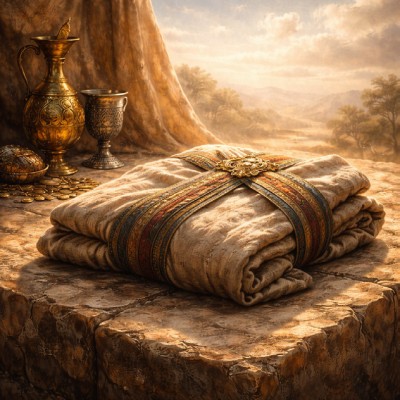
When the Jewish people left Egypt, the Torah relates that they asked the Egyptians for vessels of silver, vessels of gold, and garments. At first glance, this detail is puzzling. One of the defining traits that distinguished klal Yisrael during their centuries in Egypt was that they did not adopt Egyptian dress. For over two hundred years, they preserved their external identity, refusing to clothe themselves like idolaters. Why, then, at the very moment of redemption, did they take Egyptian garments?
The danger of adopting foreign dress is well known in our tradition. Even Amalek, the embodiment of evil, understood that clothing shapes identity. The Pardes Yosef cites Rav Shalom of Belz, zt”l, who explains that Amalek feared that if the Jewish people were to disguise themselves in Canaanite clothing, they would eventually become Canaanites in essence. Similarly, Toras Moshe teaches that Yaakov Avinu wept when he first encountered Yosef wearing Egyptian royal garments. Although Yosef’s attire was permitted due to royal protocol, the sight still pained Yaakov deeply. If the danger of foreign dress was so real, how could the Jewish people themselves take Egyptian clothing upon leaving Egypt?
The question becomes even sharper in light of the Baal HaTurim, who writes that the garments taken from Egypt miraculously lasted throughout the forty years in the wilderness. Why was such a miracle necessary? The Torah itself testifies that the people left Egypt with great wealth and abundant flocks. They could have easily produced new garments from sheep’s wool. Why, then, did Hashem perform a miracle so that these particular garments would endure?
Rashi adds another layer to the mystery. He notes that the garments were more precious to the Jewish people than the silver and gold they collected. This seems astonishing. Could it be that Egyptian clothing was more valued than wealth?
The answer reveals a profound insight into the Jewish heart.
At the moment of redemption, the Jewish people were overwhelmed with love and gratitude toward Hashem, their Redeemer. Yet they understood human nature well. They feared that with time, the memory of suffering and salvation might fade, that the miracles and wonders of the Exodus would slowly lose their vividness. In that moment of clarity, they sought something tangible — a physical reminder that would never allow them to forget.
Each person therefore took a garment specifically from the Egyptian who had oppressed him: the taskmaster who beat him during forced labor, the neighbor who had drowned Jewish children in the Nile, or the oppressor who had embedded Jewish bodies into the walls of construction. That garment was not taken for fashion or utility, but as a living memory — a constant reminder of bondage transformed into freedom.
Significantly, there was no explicit command to take garments. The Torah records a command only regarding silver and gold. The garments were taken voluntarily, born of inner feeling rather than obligation. Though they originated as garments of idolaters, the Jewish people sanctified them by transforming them into symbols of remembrance — much like parchment, which begins as animal hide but becomes holy when designated for tefillin. Through intention and purpose, the mundane was elevated into the sacred.
This idea finds a powerful parallel in modern history. Holocaust survivors have recounted how, on the day of their liberation, some donned the very striped uniforms they had worn in the camps. Those garments, once symbols of degradation, became garments of gratitude and praise to Hashem. The clothing itself testified to survival and salvation.
So too, the Jewish people wore Egyptian garments not out of attachment to Egypt, but out of love for the miracle. Such an act cannot be commanded; it arises only from the depths of the heart.
With this understanding, Rashi’s comment becomes clear. The garments were more precious than gold because they embodied the mitzvah of remembering Hashem’s kindness. And this explains the miracle as well. When Hashem saw the depth of love and spiritual sensitivity with which the Jewish people acted — choosing, of their own accord, to preserve a living reminder of redemption — He responded in kind. Their garments grew with them, were cleansed and renewed by the Clouds of Glory, and never wore out during forty years in the wilderness.
They could have made new clothing. Instead, they chose remembrance.
And because that choice was so beloved Above, Hashem ensured that their garments of memory would endure.
Based on a teaching by Rav Eliyahu Nachum Zaltzman, published in Beit Aharon V’Yisrael
Rabbi Leeor Dahan, a graduate of Yeshiva Chofetz Chaim/RSA, is a noted scholar and teacher, well-versed in halachah. He currently leads Kehilat Avodat Hashem in Hillcrest, Queens, inspiring his congregation to delve into Torah study and embrace its eternal teachings.
The Cherished Garments: Why Take Egyptian Clothing?
Typography
- Smaller Small Medium Big Bigger
- Default Helvetica Segoe Georgia Times
- Reading Mode