


Chazaq Torah Talks – Episode 100
(Originally Aired May 2, 2023)
When I sat down with Rabbi Avi Wiesenfeld for this milestone episode of Chazaq Torah Talks, the conversation felt less like an interview and more like an honest exchange about something we all live with every week — but don’t always stop to understand.
Shabbat.
Not as a slogan. Not as a checklist. But as the quiet force that shapes Jewish life from the inside out.
From London To Jerusalem
Rabbi Wiesenfeld grew up in London, England, a background that still comes through in his voice. What began as a short stay in Eretz Yisrael more than two decades ago turned into a lifelong commitment to Torah learning, teaching, and leadership.
Today, he serves as Rosh HaYeshivah of Yeshivas Beis Dovid in Jerusalem, where he guides talmidim who are sincere, motivated, and searching for depth — not just information. His approach blends solid halachic grounding with warmth, clarity, and a strong emphasis on connection to Hashem.
Beyond the yeshivah, Rabbi Wiesenfeld is widely known as a sought-after speaker, delivering practical, inspiring lectures across the world, including memorable talks given during visits back to Queens.
Teaching Halachah That People Can Live With
Rabbi Wiesenfeld has been teaching halachah for over fifteen years and is the author of widely used sefarim, including Kashrus in the Kitchen, The Pocket Halacha Series, and additional works that make complex areas of Jewish law accessible and practical.
His forthcoming work on Shabbat — nearly 600 pages, years in the making — reflects not just scholarship, but lived experience. The goal, he explained, is not to overwhelm, but to empower.
“People think learning more makes life harder,” he said.
“In reality, it opens life up.”
Why Shabbat Is Different
Shabbat, Rabbi Wiesenfeld explained, isn’t a break from life. It’s when life comes into focus.
All week we’re busy producing, reacting, running. Shabbat is when we turn toward the One who created it all. It’s the moment we stop managing the world and remember Who runs it.
That’s why Shabbat is called mekor habrachah — the source of all blessing.
Not because it adds something artificial, but because it reconnects us to the source itself.
The Power Of Details
One of the central themes of the conversation was the role of halachic detail. Many people worry that knowing more will make Shabbat restrictive. Rabbi Wiesenfeld gently challenged that assumption.
When something truly matters, every detail matters.
Just as a single missing dot can ruin an important email, overlooking the details of Shabbat weakens the connection it’s meant to create. Each halachah is another opportunity to notice Hashem — in food, in preparation, in speech, and in rest.
“The mitzvah of Shabbat,” he said, “is to find Hashem.”
Shabbat Has To Be Felt
How do you inspire someone else to keep Shabbat?
You don’t explain it first — you let them experience it.
Invite them. Let them feel the calm. The table. The conversation. The absence of pressure. Shabbat, Rabbi Wiesenfeld noted, is like the mon in the desert — it tastes like whatever you put into it. If you don’t think about it, it tastes like nothing. If you invest, it becomes unforgettable.
Children And Shabbat
When it comes to children and teens, Rabbi Wiesenfeld stressed a simple rule: never take something away unless you replace it with something better.
Kids feel everything. If Shabbat feels heavy, they’ll feel it. If it feels warm, anticipated, and wanted, they’ll carry that with them.
Excitement is contagious. So is indifference.
Shabbat needs to feel welcomed.
Is Shabbat Welcome In Our Homes?
In a closing story, Rabbi Wiesenfeld described a kallah visiting her future in-laws for Shabbat, only to feel like an inconvenience — no warmth, no presence, no time.
The question he left us with was piercing:
How welcome does Shabbat feel in our homes?
If Shabbat is greeted with anticipation, it returns with blessing. If it’s treated as an interruption, it doesn’t linger.
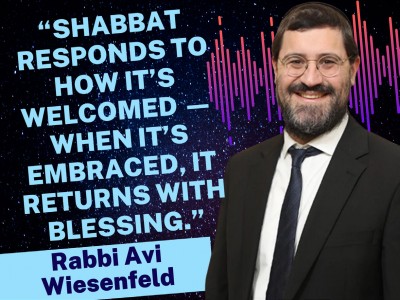
Shabbat responds to how it’s received.
And that, Rabbi Wiesenfeld reminded us, is why it remains the true source of all blessing.
Rabbi Yaniv Meirov is the mara d’atra of Kehilat Charm Circle in Kew Gardens Hills and serves as Chief Executive Officer of Chazaq. He is the host of Chazaq Torah Talks, a long-running series that explores real-life questions through honest, grounded Torah conversations.
Now with 222 episodes, Chazaq Torah Talks continues to resonate by showing that emunah is built through lived experience — not polished answers.
Rabbi Avi Wiesenfeld – The Source Of All Blessings
Typography
- Smaller Small Medium Big Bigger
- Default Helvetica Segoe Georgia Times
- Reading Mode