


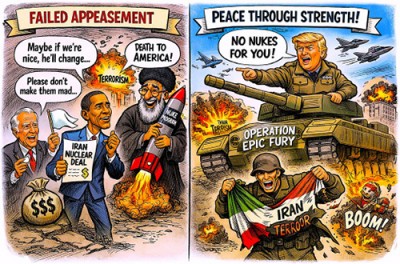
“Appeasement offers temporary comfort—but history shows it often leads to far greater danger.”
I was raised in a Democratic family and remained a Democrat until 20 years ago. But in my view, that party is not what it once was. Where is the party of FDR, Truman, and JFK—leaders who stood firmly against tyranny and placed national security above all else?
For nearly half a century, presidents of both parties—from Ronald Reagan onward—have identified Iran as the world’s leading state sponsor of terrorism. That assessment has never been partisan. It has been a consistent recognition of reality.
Iran’s regime has been linked to the deaths of hundreds of Americans over the past several decades. It has supported terrorist proxies such as Hamas and Hezbollah, fueling violence against Israel and instability throughout the Middle East. At home, it governs through repression—targeting dissidents, minorities, and women in ways that have drawn global concern.
At the same time, there has long been bipartisan agreement on a central issue: Iran must never be allowed to obtain nuclear weapons. Since the Clinton administration, that principle has been clearly stated by leaders across the political spectrum.
The debate today is not about whether Iran poses a threat—it is about how best to respond.
Critics argue that confronting Iran risks unnecessary conflict. Others contend that continued diplomacy and restraint offer the best path forward. But history suggests that delaying action against an aggressive regime can carry its own risks.
In 1938, British Prime Minister Neville Chamberlain sought to avoid war by conceding territory to Nazi Germany. He believed compromise would preserve peace. Instead, the agreement was quickly broken, and Europe was plunged into World War II—a conflict that claimed tens of millions of lives.
The lesson is often cited: when expansionist regimes are met with weakness, they may not moderate—they may advance.
Today, Iran is believed to be closer than ever to nuclear capability. Reports indicate uranium enrichment levels approaching weapons-grade thresholds, raising concerns among global security experts about how quickly that final step could be reached.
Past diplomatic efforts—including sanctions relief and nuclear agreements—have aimed to slow that progress. Supporters argue they provided oversight and restraint; critics argue they gave Iran additional resources without fundamentally changing its long-term trajectory.
This divide reflects a broader question in foreign policy: does engagement change behavior, or does it enable it?
Beyond Iran, recent global events have shaped perceptions of American resolve. In international affairs, perception matters. When adversaries believe there is hesitation, they may be more inclined to test boundaries. When strength is demonstrated clearly, it can serve as a deterrent.
A nuclear-armed Iran would have far-reaching consequences. It could shift the balance of power in the Middle East, embolden proxy groups, and potentially trigger a regional arms race. These risks are not theoretical—they are central to ongoing policy debates in Washington and beyond.
There was a time when such challenges united Americans across party lines. During World War II, the Cold War, and after September 11, national security concerns transcended politics. Today, that unity is harder to find.
Yet the core question remains unchanged: is it better to confront a growing threat early, or to delay action in hopes of avoiding conflict?
Appeasement can offer temporary calm. But history suggests that unresolved threats often grow more dangerous over time.
The stakes surrounding Iran are high—not only for the United States, but for Israel, the broader Middle East, and global stability. How those challenges are addressed will shape the future in ways that extend far beyond today’s political debates.
Editor’s Note
This article reflects the opinion of the author and is part of an ongoing conversation on matters of global security and policy impacting the Jewish community.
By Phil Orenstein
The Price Of Appeasement: Why Confronting Iran Now Matters
Typography
- Smaller Small Medium Big Bigger
- Default Helvetica Segoe Georgia Times
- Reading Mode