


Rabbi Yaniv Meirov welcomed Rabbi Yaakov May to Chazaq Torah Talks for a thoughtful and deeply personal conversation about one of the most important — and often defining — foundations of Jewish education: kindness.
For many throughout Queens, Rabbi May needs little introduction. A longtime educator and former principal of Yeshiva Tiferes Moshe, he has spent decades shaping students both inside and outside the classroom. During the interview, he reflected on the rabbeim who shaped him, the mission that guided his career, and why true Torah education can never exist without genuine care for people.
Rabbi May shared that he arrived in the United States in 1964 and later learned in the Mirrer Yeshivah, where he was influenced by great rabbeim who, in his words, “empowered us and inspired us to be marbitzei Torah.” From there, he held educational positions in Milwaukee, Suffolk County, and eventually Queens, including many years at Yeshiva Tiferes Moshe.
Yet despite the different schools and roles throughout his career, Rabbi May explained that the mission itself never changed.
He recalled how the Alter of Slabodka once sought guidance regarding the purpose of his yeshivah. The answer, Rabbi May explained, was rooted in uplifting people — “to raise the spirit of the broken and bring life to those who feel crushed.”
That, he said, remains the responsibility of every educator today.
“A yeshivah is not only a place to learn,” Rabbi May explained. “It’s a place to build people.”
Even the greatest talmidim need encouragement, support, and belief in their potential. Rabbi May noted that many future Gedolim once needed rabbeim who recognized greatness inside them long before anyone else did.
“We have to recognize that every child has to be built up,” he said. “Every child needs someone who believes in them.”
That philosophy naturally led into the evening’s central discussion: the role of kindness in Jewish education.
At Yeshiva Tiferes Moshe, Rabbi May said they often viewed the yeshivah as a “chesed organization.” The responsibility of a school extends far beyond grades or classroom performance. Educators must constantly ask themselves whether what they are doing is genuinely helping another person.
“We have to look at everything through the lens of chesed,” he said. “Am I helping this child? Am I helping this family?”
To illustrate what that responsibility looks like, Rabbi May shared a remarkable story about Rav Yechezkel Abramsky during World War II. While London was being devastated during the Blitz, Rav Abramsky refused to leave the city, remaining behind to help the Jewish community during one of its darkest periods.
When the London Beit Din building was bombed, Rav Abramsky risked his life climbing unstable piles of rubble to retrieve documents from a safe inside the destroyed building. Among the records were gittin that could later serve as proof allowing women to remarry if their husbands had been killed during the war.
“There are pictures of Rav Abramsky climbing over the rocks,” Rabbi May recounted. “One wrong move and he could have fallen. But leadership means kindness. You have to be there for people.”
Rabbi May connected that same idea to Avraham Avinu in Parashat Vayeira. Even on the third day after his brit milah — described by Chazal as the most painful stage of recovery — Avraham personally ran to care for his guests.
“He was more alive when he could do kindness,” Rabbi May observed. “If he couldn’t help others, he felt he wasn’t really living.”
Rabbi May pointed out that although Avraham delegated one small task to Yishmael — bringing water — the Torah subtly teaches the difference between kindness done personally and kindness done through someone else. Even though the Jewish People later merited water in the desert through Miriam’s well, it came through an intermediary because Avraham himself had not personally brought the water.
“The Torah’s standards for chesed are different,” Rabbi May explained. “Not only what you do — but how you do it.”
He then turned to the story of the Jewish midwives in Egypt, Shifrah and Puah, who defied Pharaoh’s orders to murder Jewish infants. Rabbi May emphasized that the Torah praises them not merely because they refused to kill, but because they actively sustained life despite the danger to themselves.
“They fed the babies, cared for them, protected them,” he said. “Every moment they were risking their lives.”
The Torah’s expectation, he explained, goes far beyond basic morality. It demands active responsibility for others.
“That’s Toras chesed,” Rabbi May said. “Not just avoiding harm — but asking: ‘What more can I do for another Jew?’”
The conversation later shifted toward the relationship between schools and parents. Rabbi May stressed repeatedly that education only succeeds when parents and educators work together as partners.
“The child should never feel abandoned by the parents,” he said. “And the school cannot succeed without the support of the parents.”
He quoted Rabbi Shlomo Brevda, who once explained that the role of parents is to support the child, while the role of the school is to educate the child. Schools sometimes need to enforce standards and expectations, but children must always know their parents remain firmly beside them with love and support.
Rabbi May also addressed children who may be more energetic, impulsive, or difficult in school settings. Rather than labeling such students negatively, he encouraged parents and educators to recognize that every child develops differently.
“No two children are the same,” he said. “Not even children from the same family.”
He recalled stories from Chazal describing young Rebbi Akiva as a particularly wild child, even bringing a goat into the beit medrash. Yet that same child eventually became one of the greatest leaders in Jewish history.
“The world didn’t end,” Rabbi May said with a smile. “Children need guidance. They need patience. They need people who understand them.”
As the interview drew to a close, Rabbi Meirov asked Rabbi May for one final message to leave with viewers.
Rabbi May returned to the same idea that had guided the entire discussion from beginning to end.
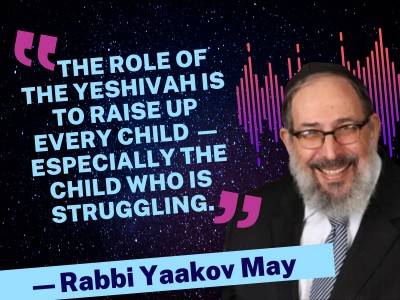
“The role of the yeshivah is to raise up every child,” he said, “especially the child who is struggling.”
A Torah institution cannot exist only for naturally gifted students or academic superstars. Real Torah education means caring for every Jewish child and helping each one reach his or her potential.
“If yeshivot were only for superstars,” Rabbi May concluded, “there would be very few people learning in kollel today.”
It was a fitting ending to a conversation that reminded listeners that authentic Jewish education is not measured only by information or achievement. At its core, it is about building people with patience, responsibility, compassion, and unwavering belief in the value of every Jewish soul.w.
Rabbi Yaniv Meirov is the mara d’atra of Kehilat Charm Circle in Kew Gardens Hills and serves as Chief Executive Officer of Chazaq. Now 222 episodes strong, Chazaq Torah Talks continues to inspire by showing that Jewish growth and survival are shaped through lived experience, commitment, and connection.
The Educator Who Refuses To Give Up On A Child
Typography
- Smaller Small Medium Big Bigger
- Default Helvetica Segoe Georgia Times
- Reading Mode