


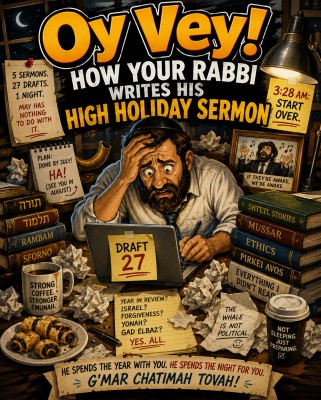
It may seem like the High Holidays are a lifetime away, but for your Rabbi, the prep for sermon writing starts now! But how does a Rabbi go about writing these sermons? What is their process? How do they constantly crank out this content again and again and again?
America’s Rebbitzman is about to peel back the parchment and expose the secrets the Rabbis have used for ages to create their High Holiday sermon. Buckle up, things are about to get weird!
Step 1: Planning
While the exact dates of Rosh Hashanah and Yom Kippur change from year to year, they generally fall between early September and mid-October. This means that every May, your Rabbi will say the following sentence:
“This year, I will get all my High Holiday sermons done by July, and then I will be able to just edit or update them closer to the date to reflect any changes in the world.”
Once this plan is put into your Rabbi’s mind, they will immediately abandon it and never speak of it again, until the following May.
Expert warning: If you ever ask your Rabbi, a month prior to Rosh Hashanah, “I thought you started writing this in May,” you will immediately have to sleep on the couch...erm, I mean, be assigned Hagbah on Simchat Torah for your weak arm.
Step 2: Ideation
The last week of August, your rabbi will come up with exactly 135 ideas for the 5 sermons they have to give (depending on how sadistic your congregation is). These 135 sermon ideas will then be broken down into 482 sub-ideas, and finally into 14,329 satellite ideas. Once these 14,946 sermon ideas are written down, cataloged, and itemized, they will be promptly crumbled up and thrown out. The result of this process means that they will settle on the following sermons:
- A year-in-review sermon
- A sermon about the State of Israel
- A sermon about a current event as it pertains to forgiveness, repentance, or acceptance
- A sermon about a social or community issue as it pertains to the Binding of Isaac or Yonah
- A sermon about Gad Elbaz, Benny Friedman, or Nissim Black’s latest song, just to see if you are still paying attention after being there for 4 hours
Expert Warning: Never say “didn’t you do that last year” or “why not give a sermon calling board members out for giving you guff” or else you will immediately have to sleep on the couch, erm I mean, be assigned apples and honey duty for the religious school during Yom Kippur.
Step 3: Building a Foundation
The research stage of writing a sermon is critical to the success of that sermon. If you have ever entered your Rabbi’s office at shul in the weeks leading up to the holy days, you may notice the bookshelves look a bit bare. That is because they take most of them home and add them to the much larger collection of books strewn around their house.
Most rabbis will then proceed to take all of these books, prayer books, Torah commentaries, stories from the shtetl, etc, and build a small structure out of them. This takes about a week to construct, and once finished, your rabbi will live within this book dwelling, much like a hobbit home. Living off of nothing but stale rugelach left over from Shabbos and by the light of their computer monitor, a Rabbi will do all the needed research for each of the 15 sermons they need to write for the Holy Days (depending on how sadistic your congregation is).
Expert Warning: Never ask if your copy of Garfield’s I Hate Mondays collection accidentally got built into the book house, or you will end up sleeping on a couch made of discarded Maxwell House Haggadot, erm, I mean, you will be assigned a new seat in the middle of the row between two known shul gossips.
Step 4: Writing the Sermon
It is now a week before Erev Rosh Hashanah, and the sermon writing can begin! This part of the process would be very similar to how you, a normal person, would write something for work or school. The research is done, the ideas are outlined, and you sit down at your computer and start writing.
For your rabbi, however, this is the exact moment when a war breaks out, there is a natural disaster, or a popular TV show is canceled without reason. At this moment, all of the above is immediately forgotten, and a new sermon that addresses these sudden events is created. These sermons are worked on night and day, into the wee hours of the morning, until it is the night before Erev Rosh Hashanah.
The night before the first service, your rabbi will experience doubts about everything they have written and, at 3:28 a.m., without fail, will throw out the new sermon and start fresh. They will then, in less than 2 hours, write all 27 sermons needed (depending on how sadistic your congregation is). Somehow, these new sermons will be spot-on perfect and hit all the notes each individual in the congregation needs to hear, even if they are contradictory from one person to the next!
Expert Warning: Do not ask your Rabbi if you can turn off the lights so you can go to sleep, or you will end up sleeping on the couch, erm, I mean, you will be escorted out of the rabbi’s house. Why are you even there that late?
This Rosh Hashanah and Yom Kippur, keep all of this in mind as you sit, listen, and then complain about how the sermon slightly hinted at some political ideology that you don’t agree with, even though it was a sermon for the children's service, where the Rabbi was singing about the whale. The whale does not signify MAGA or something left over from the Biden administration; that’s on you.
Secrets Revealed: How Your Rabbi Writes Their High Holiday Sermon
Typography
- Smaller Small Medium Big Bigger
- Default Helvetica Segoe Georgia Times
- Reading Mode