


What A Bukharian Kashrus Expert Taught Me About Living Deliberately
Before every shechitah, Rabbi Amitai Ben David performs a ritual that most consumers will never see. Holding a razor-sharp slaughtering knife in his hand, he carefully runs his fingernail across both sides of the blade, searching for the slightest imperfection. A nick so small that most people would never notice it can determine whether the animal is kosher or not.
That level of precision may seem excessive to the untrained eye. Yet during a fascinating conversation on Chazaq’s Torah Talks, Rabbi Ben David explained that the knife is only the beginning of a much larger lesson—one that extends far beyond the world of kosher meat.
Born in New Haven, Connecticut, while his parents were studying at Yale University, Rabbi Ben David grew up hearing stories about a remarkable family heritage that stretched back generations. His father’s family originated in the Bukharian Jewish community, tracing its roots to the famed Bukharian neighborhood of Yerushalayim and to Rabbi Shlomo Moussaieff, one of its founders.
The story of his family’s surname captures that heritage beautifully.
As a young boy, his grandfather attended a school in the Bukharian neighborhood. On his first day, the rebbi asked him his last name.
“Davidov,” he replied.
The rebbi immediately challenged him.
“Why Davidov? In Hebrew, you should be called Ben David.”
The comment made such an impression that the family changed its surname. What had been Davidov became Ben David, a name they carry proudly to this day.
Years later, after building successful lives in America while remaining steadfastly Shomer Shabbat, Rabbi Ben David’s grandfather returned to visit the Bukharian neighborhood where he had grown up. The experience stirred something deep within him. He gathered his children and grandchildren and challenged them with a question.
“You have such strong roots. Why are you running away from them?”
At the time, much of the family had adopted Ashkenazi customs and prayer traditions. Rabbi Ben David recalled that nobody wanted to change overnight. But his grandfather encouraged them to reconnect with their heritage slowly and thoughtfully, one step at a time. Over the years, the family gradually returned to many of the traditions and customs of their Bukharian ancestors.
That same patient approach would later shape Rabbi Ben David’s own path.
Ironically, the journey that led him into the world of kashrus began not with slaughterhouses or butcher shops, but with art.
As a yeshivah student learning the intricate laws of Yoreh Deah, he encountered a common frustration. The Gemara and poskim discussed the anatomy of animals in extraordinary detail, yet the available illustrations often failed to explain what those discussions actually looked like in practice.
Most students simply struggled through it.
Rabbi Ben David decided to draw.
He began visiting slaughterhouses and butcher shops, examining hearts, lungs, spleens, and other organs firsthand. Then he carefully sketched them, adding labels, arrows, and explanations that connected the halachic discussions to the physical reality.
What started as a personal learning aid quickly attracted attention.
Classmates repeatedly approached him after seder.
“We’re learning a new section next week. Can you draw that one too?”
One booklet became another. Then another.
Eventually those pages grew into a comprehensive work spanning hundreds of pages. What began as a simple attempt to understand difficult material became a widely used resource that helped students navigate some of the most complex areas of halachah.
The success of the book opened unexpected doors.
People invited him to deliver lectures. Communities requested demonstrations. Rabbanim encouraged him to train the next generation of shochtim and kashrus professionals.
“It wasn’t planned,” he said. “I suddenly found myself in the field.”
Then he added a sentence that revealed what truly motivates him.
“I can’t leave it anymore because I feel the responsibility.”
That sense of responsibility surfaced repeatedly throughout the discussion.
Many people assume that becoming a shochet is simply a matter of learning a technical skill. Rabbi Ben David strongly disagrees.
A successful shochet, he explained, must possess integrity, discipline, judgment, and the courage to withstand pressure.
The rules of shechitah are exacting. The knife must be perfectly smooth. The cut must be made in a precise manner. The slaughter may not be delayed. The knife may not be pressed. Even the slightest deviation can render the animal non-kosher.
A factory owner may be focused on efficiency and profit. A shochet must remain focused on one thing: halachah.
Sometimes that means stopping production. Sometimes it means rejecting meat that represents a significant financial loss. Sometimes it means standing firm when others would prefer to look the other way.
Not everyone is capable of doing that.
To illustrate why these details matter, Rabbi Ben David offered an analogy that instantly resonated.
Imagine sending an email.
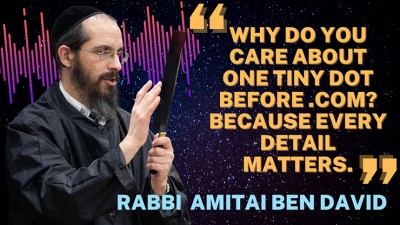
Why do you care about one tiny dot before “.com”?
After all, it is only a tiny mark.
Because without it, the entire address is wrong.
The same principle applies throughout Torah observance. Small details often appear insignificant until one understands that every detail contributes to the integrity of the whole.
In shechitah, a pause that seems inconsequential, a slight pressure on the knife, or a microscopic nick on the blade can affect the kashrus of the animal. The precision is not arbitrary. It reflects the Torah’s insistence that serving Hashem requires care and attention.
That perspective also helps explain one of the questions he hears most often.
Why is kosher meat so expensive?
Part of the answer is straightforward. Kosher meat requires additional procedures, inspections, supervision, salting, and processing. More people are involved. More time is invested. More safeguards are implemented.
But Rabbi Ben David pointed to another factor: standards.
In some facilities, production lines move rapidly. In others, they move more slowly to allow for additional inspections and oversight. Some operations rely on minimal staffing. Others maintain larger teams of experienced professionals to ensure that nothing is overlooked.
The difference, he explained, is similar to choosing an experienced dentist over someone who completed a quick training course.
Most people instinctively understand why expertise matters.
The same is true in kashrus.
Throughout the interview, however, Rabbi Ben David repeatedly steered the conversation away from technical details and back toward something larger.
Awareness.
Before eating, he encouraged listeners to pause.
Look at the package.
Read the label.
Check the certification.
Think about what you are consuming.
Too often, people move through life on autopilot. The Torah’s system of kashrus reminds us that holiness is found not only in grand moments but also in ordinary decisions made with awareness and intention.
By the time our conversation ended, I realized that despite spending nearly an hour discussing kosher meat, Rabbi Ben David was really teaching a lesson about life.
The knife, the inspections, the labels, and the standards all point toward the same truth.
Meaningful Jewish living begins when we stop rushing through our choices and start paying attention.
For Rabbi Ben David, every detail matters—not because details are important in themselves, but because every detail is another opportunity to serve Hashem thoughtfully.
Rabbi Yaniv Meirov is the mara d’atra of Kehilat Charm Circle in Kew Gardens Hills and serves as Chief Executive Officer of Chazaq. Now 222 episodes strong, Chazaq Torah Talks continues to inspire by showing that Jewish growth and survival are shaped through lived experience, commitment, and connection.
Every Detail Matters
Typography
- Smaller Small Medium Big Bigger
- Default Helvetica Segoe Georgia Times
- Reading Mode