


One presidential portrait is now being struck in metal. One presidential signature is being added to paper currency.
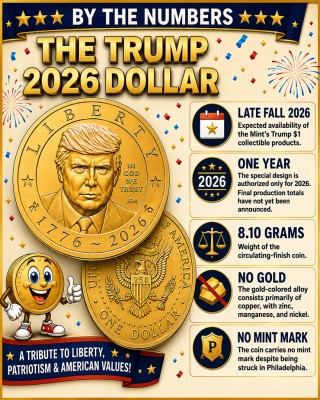
On July 15, Treasury Secretary Scott Bessent unveiled the final design of a new $1 coin bearing President Donald J. Trump’s portrait as part of America’s 250th anniversary celebration. The U.S. Mint has begun producing the coin at its Philadelphia facility, with collectible products expected in late fall.
The obverse, or heads side, presents a forward-facing portrait of Trump surrounded by the inscriptions “LIBERTY,” “IN GOD WE TRUST,” and “1776 ~ 2026.” The reverse carries the Presidential Seal: a bald eagle holding an olive branch and arrows, with “250” placed inside its shield. “UNITED STATES OF AMERICA,” “E PLURIBUS UNUM,” and “ONE DOLLAR” complete the design.
Despite its gold color, the finished $1 piece contains no gold. Its alloy consists primarily of copper, with zinc, manganese, and nickel. The circulating-finish coin weighs 8.10 grams, measures slightly more than an inch across, has a plain edge, and carries no mint mark despite being struck in Philadelphia.
The special Trump design is authorized for 2026 alone. That makes it a one-year anniversary issue, but not necessarily a limited-mintage release. The Mint has not yet announced how many Trump coins it will produce, what the collectible products will cost, the exact sales date, or whether buyers will face household ordering limits.
Bessent described the coin as a tribute to liberty, patriotism, and American values. Trump called the coin “very unusual,” said he was honored, and later described it as “very cute.”
The legality of the coin and its review process remain disputed. The law governing the Semiquincentennial program prohibits a portrait of a living person on the reverse. Trump’s portrait appears on the obverse, while the Presidential Seal occupies the reverse. Critics question whether that distinction resolves the legal issue. Members of the Citizens Coinage Advisory Committee told ABC News that they never saw the final design, raising separate questions about whether the required review process was followed. The Mint has disputed that account, saying the committee was offered multiple opportunities to review the proposed designs but declined and that the Mint therefore fulfilled its obligation to seek the committee’s advice.
Trump is not the first sitting president to appear on a U.S. coin. In 1926, Calvin Coolidge appeared alongside George Washington on a half dollar marking the nation’s 150th anniversary. More than one million were struck, but weak sales led to 859,408 being returned to the Mint and melted. A century later, the Trump dollar revives both the precedent and the controversy.
The $1 coin is not the only major change coming to American currency.
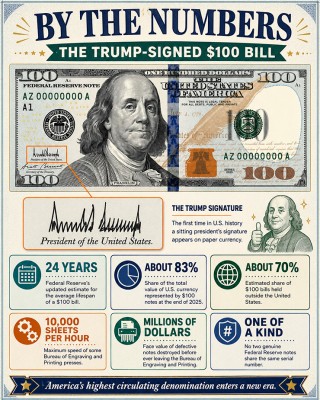
On July 3, President Donald J. Trump posted an image of a $100 bill bearing his signature, tying the new note directly to America’s 250th anniversary celebration. Treasury had announced in March that Trump’s signature would appear alongside Treasury Secretary Scott Bessent’s, marking the first time a sitting president’s signature would appear on U.S. paper currency. Treasury officials said the first $100 bills were scheduled for printing in June, with circulation expected to unfold gradually through the banking system.
The note preserves the familiar two-signature arrangement, replacing the U.S. Treasurer’s signature position with Trump’s while retaining Bessent’s signature. Earlier notes generally paired the Treasurer and Register of the Treasury, while modern Federal Reserve notes came to carry the signatures of the Treasury secretary and U.S. Treasurer.
U.S. Treasurer Brandon Beach called Trump’s signature appropriate and “well deserved” and said the new currency would recognize the president’s place in American history.
Benjamin Franklin’s portrait remains untouched. Franklin never served as president, yet few people shaped the nation’s founding more profoundly. A printer, inventor, diplomat, scientist, and Founding Father, Franklin helped define the country’s earliest years. More than two centuries later, the man whose printing presses shaped public debate during America’s founding remains the face of America’s highest circulating denomination.
The United States changes the basic appearance of its banknotes infrequently, with familiar portraits remaining in place for generations. That makes even a signature substitution notable.
For retailers, the announcement raises an immediate concern: Will a change to the nation’s most valuable circulating bill create confusion at the cash register?
“Whenever a new banknote enters circulation, criminals often try to exploit the confusion,” said Avraham Pinkhasov, Coordinator of Queens Shmira. “Businesses should familiarize themselves with the updated security features and continue using the same careful counterfeit detection practices they’ve always relied upon. The new signature doesn’t change how a legitimate $100 bill feels or its built-in security features, but awareness is always one of the best defenses.”
It is easy to imagine Treasury announcing a new note on Monday and banks receiving it on Tuesday, but the process does not work that way.
Before the first Trump-signed bills reach neighborhood banks or ATMs, they pass through a production process that most people never see. Steel plates are prepared, specialized inks are tested, and sheets are printed in stages.
Few Americans will ever visit the Bureau of Engraving and Printing, yet nearly everyone carries its craftsmanship in a wallet or purse. Despite the common phrase “paper money,” a U.S. note is not made from ordinary wood-pulp paper. Its material is 75 percent cotton and 25 percent linen, with colored fibers distributed throughout to make imitation more difficult.
High-speed presses can process as many as 10,000 sheets per hour. The printing is layered: background colors, engraved intaglio elements, serial numbers, Federal Reserve identifiers, and Treasury seals are added at separate stages. Some sheets must dry for days between printing stages, while sophisticated cameras inspect them for minute flaws before the sheets are cut and packaged.
A blurred line, poor alignment, or defective number can prevent a note from ever entering circulation. Each accepted note receives a serial number that, together with its series designation and Federal Reserve identifiers, distinguishes it from other notes.
The new signature does not alter the $100 bill’s familiar security features. Cash handlers can still check the Franklin watermark and embedded security thread by holding the note to light. Tilting it reveals the blue 3-D security ribbon and color-shifting elements, while raised intaglio printing gives genuine currency its distinctive texture.
At the end of 2025, $100 bills accounted for nearly $1.99 trillion of the approximately $2.39 trillion in U.S. currency outstanding—about 83 percent of the total value.
Using a methodology updated in 2025, the Federal Reserve estimates that a $100 note has an average lifespan of 24 years. Larger denominations last longer because they change hands less frequently and are often stored rather than spent.
Federal Reserve research estimates that roughly 60 to 70 percent of all $100 bills were held abroad at the end of 2022, with the various methods centering around 65 percent. In economies with unstable currencies, crisp American hundreds often serve as emergency savings or a secondary store of value.
America did not always stop at $100. The government once circulated $500 notes featuring William McKinley, $1,000 notes featuring Grover Cleveland, $5,000 notes featuring James Madison, and $10,000 notes featuring Salmon P. Chase. The $100,000 Gold Certificate bearing Woodrow Wilson was reserved for transfers between Federal Reserve Banks and never circulated publicly. High-denomination notes were discontinued in 1969 because of declining use, although surviving examples remain legal tender and are generally worth far more to collectors than their face value.
These developments follow Treasury’s suspension of circulating penny production. U.S. Treasurer Brandon Beach struck the final circulating one-cent coin in Philadelphia on November 12, 2025, concluding a 232-year run. By then, manufacturing each penny cost 3.69 cents. Existing pennies remain legal tender, and the Mint may continue producing collector versions, but no new cents are being made for ordinary circulation.
A third proposal remains far less certain.
The “Donald J. Trump $250 Bill Act,” H.R. 1761, would create a new Federal Reserve note bearing Trump’s portrait. The measure, introduced by Rep. Joe Wilson of South Carolina, has been referred to the House Financial Services Committee and has not passed either chamber of Congress.
Unlike the $1 coin, a $250 note cannot be created under Treasury’s existing Semiquincentennial coin authority. Congress would need to authorize the new denomination and amend the law barring portraits of living people on U.S. paper currency. Treasury has nevertheless prepared a concept in anticipation of possible congressional approval. Bessent has characterized the work as advance planning rather than a final decision.
The proposal has also drawn scrutiny from five Democratic senators—Elizabeth Warren, Jeff Merkley, Catherine Cortez Masto, Ron Wyden, and Chuck Schumer—who asked Treasury’s inspector general to investigate how much government time and money had already been spent developing the concept. Their letter argued that Treasury could neither create a $250 denomination nor place a living president’s portrait on it without Congress first changing the law.
Collectors, meanwhile, have two confirmed Trump-related issues to consider before a $250 bill ever becomes reality.
The $1 coin’s one-year design gives it immediate anniversary appeal, but its future value cannot be predicted until the Mint discloses production totals and sales formats. A coin produced in very large numbers may remain worth little more than one dollar, while low-mintage products, unusual errors, unopened Mint rolls—if offered—and pristine professionally graded examples could draw premiums.
The Trump-signed $100 bill presents a different kind of hunt. Numismatists prize star notes, ascending “ladders,” palindrome “radars,” birthday serials, and exceptionally low numbers. On this series, combinations incorporating 1776 or 2026—and sequences such as 00000001, 00000100, and 00000250—could attract premiums. Collectors may preserve pristine examples from the earliest production runs or submit them to grading services such as PMG or PCGS Banknote.
The coin and note are likely to be treated very differently. Collectors may set aside many Trump dollars rather than spend them. The $100 bill was made to move—through bank vaults, ATMs, wallets, cash drawers, and across borders.
History will not sit entirely behind glass. Some of it will be sealed in protective holders; some will be folded into wallets and spent. Long after the fireworks marking America’s 250th anniversary have faded, Trump’s portrait on the $1 coin and his signature on the $100 bill may remain among the celebration’s most recognizable—and most debated—artifacts.
By Shabsie Saphirstein
Trump $1 Coin Enters Production; Trump-Signed $100 Bill Moves Toward Circulation. Could A $250 Note Be Next?
Typography
- Smaller Small Medium Big Bigger
- Default Helvetica Segoe Georgia Times
- Reading Mode