


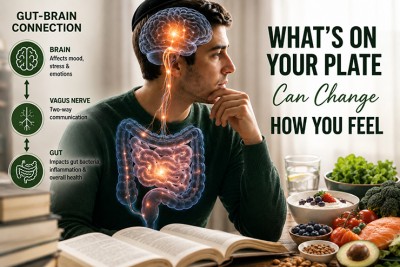
When we talk about mental health, the conversation almost always focuses on what is happening from the neck up—neurotransmitters, thought patterns, emotional regulation, and brain chemistry. But modern nutritional psychiatry and microbiome research are increasingly asking us to look lower: specifically, at the gut.
Could certain mental health challenges, including depression and anxiety, be connected in some way to the complex microbial ecosystem living in our digestive tract?
Research increasingly suggests an association between the gut microbiome and mental health. Scientists are still working to understand exactly how strong that connection is, what causes what, and how it might eventually be used in treatment. But one thing has become increasingly clear: the brain and digestive system are in constant communication.
The Vagus Nerve And The Gut-Brain Axis
The connection between the digestive system and the brain is not merely metaphorical. Scientists refer to this two-way communication system as the gut-brain axis.
One important part of that system is the vagus nerve, a long neural pathway connecting the brainstem with organs throughout the body, including the digestive tract.
But the conversation between gut and brain does not occur through the vagus nerve alone. The immune system, hormones, microbial metabolites, inflammation, and other neural pathways are also involved.
The gut is home to trillions of microorganisms collectively known as the gut microbiome. These microbes interact with the body in remarkably complex ways. The digestive tract is also involved in the production of a large portion of the body’s serotonin, although serotonin produced in the gut does not simply travel into the brain and become brain serotonin.
What happens in the gut can nevertheless influence signals that reach the brain.
When the balance of microorganisms in the gut is disrupted—a state known as dysbiosis—changes in microbial metabolites, immune activity, inflammation, and nerve signaling may affect the way the brain responds to stress and regulates mood.
Researchers have found associations between alterations in the gut microbiome and conditions including depression and anxiety. That does not mean gut bacteria have been proven to cause these disorders. Mental health is far too complex for such a simple explanation. But the emerging research suggests that the gut may be one piece of a much larger puzzle.
Elaine Gottschall’s Theory, SCD, And The GAPS Connection
The idea that intestinal health can influence overall wellness is not entirely new.
Biochemist Elaine Gottschall helped popularize the Specific Carbohydrate Diet (SCD) through her book Breaking the Vicious Cycle. The diet itself had earlier origins, but Gottschall became one of its best-known advocates.
The theory behind SCD is that certain carbohydrates may be more difficult for some people to digest completely. The diet therefore restricts many grains, starches, and refined sugars while allowing selected foods containing simpler carbohydrates.
The Theory Behind SCD
Targeting Carbohydrate Structure: SCD restricts many complex carbohydrates and focuses instead on foods considered easier to absorb.
Reducing Substrate For Certain Gut Microbes: The theory proposes that poorly absorbed carbohydrates may remain available for intestinal microbes to ferment, potentially contributing to digestive symptoms or microbial imbalance in susceptible individuals.
Supporting Intestinal Health: By changing which carbohydrates reach the digestive tract, proponents of SCD believe the diet may help create conditions that support improved intestinal function.
It is important, however, to distinguish the theory behind the diet from what research has definitively established.
SCD has been studied primarily in gastrointestinal disorders such as Crohn’s disease and ulcerative colitis, but its possible implications may extend beyond digestive symptoms. GAPS (Gut and Psychology Syndrome), a nutritional protocol developed from principles of SCD, has also been used in people with psychiatric and neurodevelopmental conditions, including autism.
Published case reports, small studies, and clinical observations have described significant behavioral, cognitive, and emotional improvements in some individuals following SCD- or GAPS-style dietary interventions. These reports should not be dismissed; they provide potentially important observations that warrant further investigation.
What About Mood, Anxiety, Brain Fog, And Neurodevelopmental Symptoms?
This is where the story becomes particularly interesting—but also where we need to be careful.
Some people who follow SCD-, GAPS-, or other gut-focused dietary approaches report improvements not only in gastrointestinal symptoms but also in energy, concentration, mood, anxiety, brain fog, and—in some reported cases—behavioral or developmental functioning.
These reports are meaningful, particularly when improvements are significant and sustained. At the same time, case reports and uncontrolled observations cannot establish that the dietary intervention itself caused the improvement.
A recently published SCD case report, for example, described striking and sustained improvement in a child diagnosed with autism. Such cases help generate important clinical questions and should encourage further study rather than being dismissed simply because they do not yet constitute large randomized trials.
The current evidence is therefore best described as promising but preliminary. Controlled clinical research—especially for psychiatric and neurodevelopmental conditions—remains limited.
The scientific question is not simply, “Can food affect how we feel?” Clearly, it can. The more difficult question is: Which dietary approaches help which people, through which mechanisms, and to what degree?
Researchers are still working on those answers. Larger, well-controlled studies are needed to determine who may benefit, which components of these dietary approaches matter most, and how durable the effects may be.
How Understanding The Body Helps Defeat Stigma
One of the most valuable lessons emerging from gut-brain research may have less to do with any particular diet and more to do with how we understand mental health itself.
For generations, society has too often treated depression, anxiety, and other mental health struggles as personal failings, character flaws, or signs that someone simply needs to “think differently.”
The growing study of the gut-brain axis reinforces something clinicians have long understood: mental health involves real biological processes.
Those processes do not exist in isolation. Genetics, brain function, hormones, inflammation, sleep, nutrition, life experiences, relationships, stress, and psychological patterns can all interact.
Recognizing the biological dimensions of mental illness does not mean reducing depression or anxiety to the gut—or to any single organ or chemical. It means understanding that mental health is inseparable from physical health.
That realization can help replace blame with compassion.
Taking Action: Collaboration And Professional Guidance
If you are interested in exploring whether nutrition and gut health may be affecting how you feel, the key is to approach it thoughtfully rather than jumping from one restrictive diet to another.
- Work With A Registered Dietitian
A registered dietitian—particularly one familiar with gastrointestinal health or nutritional psychiatry—can help evaluate your current diet and determine whether changes may be appropriate.
If you are considering a restrictive eating plan such as SCD, professional guidance becomes especially important. Eliminating entire categories of foods can make it more difficult to obtain adequate calories, fiber, vitamins, and minerals if the diet is not properly planned.
- Prioritize
Collaborative CareAlways speak with your physician, psychiatrist, therapist, or other appropriate healthcare professional before making major dietary changes that could affect an existing medical or mental health treatment plan.
Nutrition can be an important complementary tool. But dietary changes should not be presented as a replacement for evidence-based psychotherapy, psychiatric medication, or medical treatment when those interventions are needed.
The most promising lesson of gut-brain research is not that we have discovered one diet that can cure depression or anxiety.
It is that the human body is extraordinarily interconnected.
What we eat, how we sleep, how we move, how we manage stress, our physical health, our relationships, and our psychological well-being can all influence one another.
By approaching wellness holistically—caring for the mind, the body, and the biome—we open additional avenues for healthier living while remaining grounded in responsible, evidence-based care.
David Kahan is a Licensed Clinical Social Worker and Psychotherapist with over a decade of experience. He has worked in various mental health clinics and is now seeing clients in private practice. He can be found and may be booked through Alma. He is currently accepting clients with new or established mild to moderate mental health diagnoses and can be reached at This email address is being protected from spambots. You need JavaScript enabled to view it. or 718-350-5408.
The Mind-Gut Connection: Could What’s On Your Plate Change How You Feel?
Typography
- Smaller Small Medium Big Bigger
- Default Helvetica Segoe Georgia Times
- Reading Mode