


In Queens, A Language Still Heard Every Day Faces A Generational Test
There is a conversation taking place at Bukharian tables across Queens that can sound perfectly natural to the family having it — and rather unusual to anyone listening from outside.
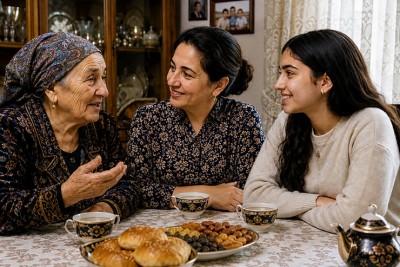
Grandma asks a question in Bukhori. Her daughter responds in Bukhori or Russian. The granddaughter understands what Grandma said but answers in English. Everyone understood everyone.
For now.
That last part is what makes the scene worth considering.
Queens is home to one of the largest Bukharian Jewish communities anywhere in the world. The Endangered Language Alliance estimates that roughly 40,000 to 50,000 Bukharians live in the community centered around Forest Hills and Rego Park, and says Bukhori is still used regularly in family life, business and some religious settings. Walk along 108th Street and it is not difficult to hear it.
Yet the same organization that describes Bukhori as a living language also warns that its long-term future is uncertain. The reason is straightforward: fewer young Bukharians speak it.
For a community that has successfully rebuilt so much of its life in Queens, that raises an intriguing question: What happens when the grandchildren remain proudly Bukharian, but no longer speak the language of their grandparents?
A Language With A Jewish Story
Bukhori is sometimes described simply as “Bukharian,” but its history is considerably richer. It is a Southwestern Iranian language closely related to Tajik and, more distantly, Persian. Centuries of Jewish life also brought Hebrew and Aramaic words into its religious and cultural vocabulary, while life alongside Uzbek speakers influenced the language as well.
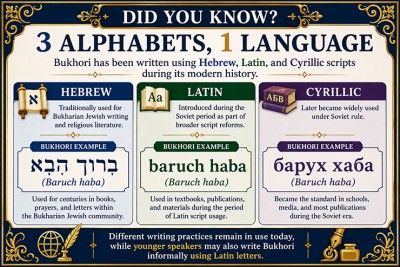
Its history can almost be read through its alphabets. Bukhori was traditionally written using Hebrew letters. During the Soviet period, other scripts were introduced, and Cyrillic eventually became widely used. Romanized versions followed.
Hundreds of books were published in Bukhori, and the language once supported textbooks, newspapers, poetry and theater. That trajectory changed under Soviet rule, and by 1940 official promotion of a separate Bukharian Jewish language had been banned. Russian became the language Bukharian children encountered in school and, increasingly, the language of public life.
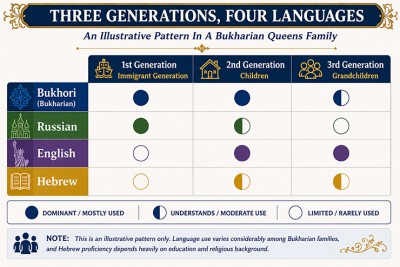
That history helps explain a linguistic pattern still found in Queens. Many older Bukharians know Bukhori and Russian. Their children may know both but increasingly use English, while their grandchildren may understand Bukhori without speaking it comfortably.
From History To Today: Preserving The Words Of Our People
The effort to preserve Bukhori did not begin in Queens. Rabbi Shimon Hakham, a towering figure in Bukharian Jewish literary history, helped make Jewish texts accessible in Bukhori and used Hebrew letters to write the language.
More than a century later, preservation has taken a new form in Queens: university courses, textbooks, museum collections and digital recordings of native speakers. The technology has changed, but the purpose is strikingly familiar — ensuring that another generation can understand the words of the one before it.
Queens Has Something Most Endangered Languages Don’t
There is an important reason this story should not be written as an obituary for Bukhori. The language is still here. Fluent speakers are still here. And some of them are being recorded.
The Endangered Language Alliance’s Jewish Languages Initiative has been recording Bukharian stories, conversations, life histories and religious discussions in Queens. Among those whose voices and knowledge have been documented are Rabbi Boruch Babayev, Rabbi Ezra N. Nezri, Rabbi Asher Vaknin, Rabbi Zalman Zavulunov, Aron Aronov, Albert Yakobov, Rabbi Eliezer Niyazov and Rabbi David Akilov.
These recordings preserve more than vocabulary. They capture accents, humor, turns of phrase and the rhythm of Bukhori spoken naturally.
There are also dictionaries and teaching materials, including Easy Bukharian, published in New York in 2012 by Imonuel Rybakov. Rybakov went on to teach Bukharian Jewish studies at Queens College, bringing Bukhori into an American university classroom.
More Than Vocabulary
Language carries information that translation does not always preserve neatly. Humor is different. Affection sounds different. Sometimes the language preserves pieces of Jewish history — Hebrew and Aramaic words that testify to generations of Jewish life in Central Asia.
A Bukharian teenager in Queens may speak English at school, learn Hebrew in yeshivah, hear Russian from his parents and understand Bukhori from his grandparents. That is a remarkably layered Jewish identity. The question is whether one of those layers eventually disappears.
“I Understand, But I Don’t Speak”
That may be the sentence that matters most. Ask younger members of many immigrant communities whether they speak their grandparents’ language and some variation appears: “I understand it.” “My parents speak it.” “I know some.” “I understand more than I can say.”
A child can grow up understanding a language because Grandma speaks it constantly without ever becoming comfortable speaking it himself. If the parents then speak English to that child, the next generation may hear very little Bukhori at all.
No family decided to abandon the language. Each generation simply used it a little less.
Bukharian Jews are hardly alone in this. American Jewish history is filled with languages that weakened after immigration. Bukhori, however, has an advantage those languages did not always have when their American decline accelerated: We can see what is happening, and today’s technology makes preservation remarkably easy.
Grandma Doesn’t Need A Recording Studio
Put a phone on the kitchen table. Ask questions in Bukhori. Let Grandma answer. A twenty-minute recording that seems ordinary today may become one of a family’s most treasured possessions decades from now.
Use Bukhori expressions with children. Let grandparents speak without immediately translating every sentence.
Perfect fluency does not have to be the only definition of success. A child who knows fifty expressions has inherited more than a child who knows none.
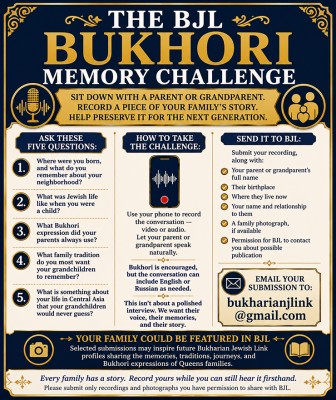
The BJL Bukhori Memory Challenge
Sit down with a parent or grandparent and record part of your family’s story. Ask where they were born, what Jewish life was like when they were children, which Bukhori expressions their parents always used, which family tradition they most want their grandchildren to remember, and what about their life in Central Asia their grandchildren would never guess.
Let them answer naturally. Save the speaker’s full name, birthplace and date of recording with the file.
Readers may submit recordings and basic family information to This email address is being protected from spambots. You need JavaScript enabled to view it.. Selected submissions may inspire future BJL features.
What Are We Actually Trying To Save?
Preserving Bukhori does not require every Bukharian child in Queens to become a fluent speaker.
The more immediate question is whether Bukhori remains something young Bukharians recognize as theirs.
Queens has something extraordinarily valuable at this moment. The generation that brought Bukharian life from Central Asia is still sitting at our tables. The language is still heard in homes and businesses. The recordings can still be made. The questions can still be asked.
There may come a time when preserving Bukhori requires reconstructing something that has largely disappeared. We are not there yet. Right now, preservation can begin with something much simpler.
Grandma speaks. The grandchild listens. And perhaps, this time, answers her in Bukhori.
By Shabsie Saphirstein
When Grandma Speaks Bukhori And The Grandchildren Answer In English
Typography
- Smaller Small Medium Big Bigger
- Default Helvetica Segoe Georgia Times
- Reading Mode