


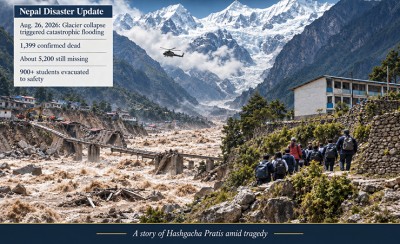
In the aftermath of the devastating glacier collapse and flooding that struck Nepal on August 26, an extraordinary story has emerged with an unexpected Jewish connection and a powerful lesson in Hashgacha Pratis. The account, related by R’ Moshe Mernick in a TorahAnytime presentation, concerns a Jewish tour group whose carefully planned trip never took place — for a reason that initially may have seemed like little more than a frustrating disappointment.
According to R’ Mernick, the group had planned to travel first to Sri Lanka and then continue on to Nepal. As the departure approached, however, several participants backed out, leaving only nine people. The organizer had insisted that the group travel with a minyan, and with only nine participants remaining, the entire trip was canceled. After all the planning and anticipation, it would have been understandable for those involved to question whether canceling the journey over one missing participant was really necessary.
Then came August 26, the very day the group reportedly had been scheduled to arrive in Nepal. That morning, a massive glacier collapse high in the Himalayas near Nepal’s border with Tibet sent an enormous quantity of ice, rock, and sediment crashing more than 1,200 meters into the valley below. According to experts who examined satellite imagery and seismic data, the collapse triggered a catastrophic chain of events that sent floodwaters surging through downstream river systems, including the Bhote Koshi and Trishuli. In some areas, water levels rose by as much as nine meters within approximately 30 minutes, destroying communities, roads, bridges, homes, and critical infrastructure.
The scale of the disaster has become even clearer in the weeks since. As of September 16, Nepal’s National Disaster Risk Reduction and Management Authority reported that at least 1,399 people had been confirmed dead, while approximately 5,200 remained missing, including 636 foreign nationals. Authorities have collected DNA samples from more than 1,200 unidentified bodies as families continue the painful process of searching for loved ones. Rescue operations are still underway, particularly around damaged hydropower facilities and tunnels, where specialized teams, helicopters, and drones have been deployed.
Against that backdrop, the cancellation of the Jewish tour takes on an entirely different meaning. There is no way to know exactly where the travelers would have been when the disaster struck, and it would be wrong to claim with certainty that their lives would have been endangered. What is known, according to R’ Mernick’s account, is that they were supposed to arrive in Nepal on the very day catastrophe struck — and that their trip was canceled because they could not assemble a minyan. What had appeared to be an unfortunate setback suddenly became something for those involved to view through the lens of Hashgacha Pratis.
That is perhaps what makes the story so striking. We often experience events only from the perspective of the moment in which they occur. A trip is canceled, an opportunity disappears, a plan falls apart, or something we were certain would happen simply does not. At the time, all we can see is the inconvenience or disappointment. Occasionally, however, circumstances later allow us to look backward and recognize that the closed door may have led us away from something we could never have anticipated. For a believing Jew, such moments reinforce the knowledge that our understanding is necessarily limited. We make our hishtadlus, try to fulfill mitzvos, and proceed according to the information available to us, while recognizing that HaShem sees an infinitely larger picture.
Amid the tremendous suffering in Nepal, another remarkable story demonstrates how a seemingly small decision made at precisely the right moment can alter hundreds of lives. At Tribhuvan Trishuli Secondary School in Nepal’s Nuwakot district, approximately 900 students were attending school on the morning of August 26 when principal Rajendra Dawadi began receiving urgent warnings that floodwaters were racing toward the area. Rather than waiting for official confirmation or risking precious minutes, Dawadi immediately ordered the evacuation of the school, instructed approaching school buses to stay away, and directed students and faculty toward higher ground. The flood arrived only minutes later and devastated the school. Nearly everyone had already escaped, although two teachers were reported missing.
The school evacuation became one of the few rays of hope to emerge from an otherwise overwhelming tragedy. Hundreds of children survived because warnings reached the right person in time and because that person acted without hesitation. The circumstances are very different from those surrounding the canceled Jewish tour, yet both stories remind us how quickly an ordinary decision can take on extraordinary significance once we understand what happened afterward.
Nepal, meanwhile, faces years of recovery. The flooding damaged or destroyed hydropower plants, roads, bridges, homes, and other infrastructure across the affected region. With hydropower supplying almost all of Nepal’s electricity, the destruction was so extensive that India has authorized emergency electricity exports of up to 654 megawatts to Nepal through the end of the year. Nepal has also appealed to the international community for billions of dollars in assistance as it confronts the enormous task of rebuilding.
There have even been extraordinary rescues weeks after the flood. Sanjay Sah, a mechanical foreman at the Upper Trishuli 3A Hydropower Station, survived for nine days trapped inside a darkened hydropower tunnel, sustaining himself on floodwater and seepage water until rescuers finally reached him. After hospitalization, he was able to return home to his family — a rare moment of joy amid a disaster in which so many families are still waiting for answers.
None of these stories diminishes the terrible suffering of those who lost relatives, homes, or livelihoods, nor can we presume to understand why some people were spared while so many others were not. Hashgacha Pratis is not an invitation to explain tragedy or to claim knowledge of Heaven’s calculations. Rather, the story of nine Jewish travelers who never reached Nepal offers a more personal reminder: When something does not go according to plan, we rarely know the full significance of what has occurred.
Our tefillos are with the people of Nepal as rescue and recovery efforts continue — that additional survivors should be found wherever possible, that the injured should have a complete recovery, that families should receive answers concerning their missing loved ones, and that those who perished should be brought to proper burial. We pray as well for an end to tragedy and suffering throughout the world.
For the Jewish travelers whose journey ended before it ever began, however, August 26 offered a perspective they could not possibly have had when their plans were first canceled. They were one person short of a minyan, and because of that, they stayed home. What initially looked like a closed door may have been something else entirely — a protection whose significance became visible only afterward.
By S.R.
When A Missing Minyan Became A Hidden Salvation
Typography
- Smaller Small Medium Big Bigger
- Default Helvetica Segoe Georgia Times
- Reading Mode