


You may have heard that every pomegranate has exactly 613 seeds, corresponding to the 613 mitzvot in the Torah. It is one of those familiar ideas that comes up around the Rosh Hashanah table each year. Short of actually counting the seeds—which has certainly been suggested at our table!—I decided to look into it.
The answer is that not every pomegranate has exactly 613 seeds. The number varies considerably depending on the variety, size, and growing conditions. Some research has found pomegranates with only a few hundred seeds and others with well over a thousand. Many, however, contain somewhere around 600 seeds, which may help explain the familiar association with 613.
More importantly, there is a Torah basis for connecting the rimon with the number 613, although it does not appear explicitly in Chazal. My father once told me that he had seen Rav Chaim Kanievsky zt”l say that there is no source in Chazal stating that a rimon contains 613 seeds. Rav Chaim did, however, cite a later source, which my father remembered as the Malbim. I subsequently found the reference in the Malbim’s commentary to Shir HaShirim (4:3). The Chatam Sofer also discusses the idea in a derashah for Shabbat HaGadol 5591 (1831). Thus, the association has significant precedent among gedolim of approximately two centuries ago, even though it is not stated in the Gemara.
What Chazal do say is perhaps even more meaningful. Based on pesukim in Shir HaShirim (4:3 and 6:7), the Gemara teaches that even the “empty” among the Jewish people are filled with mitzvot like a rimon is filled with seeds. The lesson is not about a precise number, but about how densely the fruit is packed—and, by comparison, how much spiritual merit can be found within every Jew.
This theme appears in numerous places in Chazal, including Eruvin 19a, Megillah 6a, Chagigah 27a, Sanhedrin 37a, Shir HaShirim Rabbah 4:3, and Zohar, Mishpatim 100a. The Chatam Sofer cites the concept in a halachic discussion on Pesachim 49b. The Netziv, in Meromei Sadeh to Chagigah 27a, explains that among the mitzvot with which Jews are especially filled are tzedakah and gemilut chasadim. Interestingly, even the English word “pomegranate” reflects the fruit’s abundance of seeds, ultimately deriving from Latin terms referring to a seeded apple.
When 613 Sounds Like a Good Age
The connection between the rimon and 613 mitzvot produced a memorable comment from my three-year-old nephew, Yitzy. We are both eineklach of the Chatam Sofer.
Yitzy heard that his cousin, who is the same age, had stopped using a bottle. Yitzy still used one when going to sleep and upon waking, so he told his mother, “I’m also going to stop using a bottle one day—maybe when I’m four.” Later, he looked thoughtful and said, “Four is kind of a little number.”
“So what is a better number?” his mother asked. Yitzy had an answer ready: “I’ll wait till I’m 613, because my morah said there are 613 seeds in a rimon and 613 mitzvot in the Torah!” Apparently, 613 sounded much more impressive than four.
A Simple Way to Open a Pomegranate
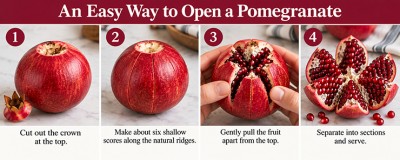
There is also a remarkably easy way to open a pomegranate without making the usual mess. First, cut out the crown at the top. Then make about six shallow vertical cuts down the outside of the fruit, evenly spaced around it. Many pomegranates have visible vertical ridges marking the divisions between their internal sections. Cutting along those ridges makes the process even easier, although it is not essential.
Next, gently pull the fruit apart from the top. Rather than slicing through the seeds and sending juice everywhere, the pomegranate separates into sections, somewhat like an orange. The sections can then easily be passed around the table.
There may even be an interesting remez in Chazal to the way a rimon naturally separates. In Masechet Orlah (3:9-10), the Mishnah discusses various conditions affecting produce and uses the expression nispardu harimonim—the pomegranates became separated. The sefarim explain the phrase as referring to the seeds separating from the fruit. Interestingly, when the Mishnah discusses gourds, it describes them as being “cut,” while the pomegranates are described as “separated.”
This is not an instruction from Chazal on how to open a pomegranate, nor does it prove that one should first make shallow cuts along its exterior. It does, however, reflect the natural structure of the fruit: a rimon is made up of sections that can be pulled apart. Scoring the outside simply makes that separation easier.
There is another useful point about eating a pomegranate. There is no need to chew the juicy portion and spit out the hard center. The entire aril, including its crunchy inner seed, is edible and provides fiber and other nutrients. Eating the whole fruit is therefore nutritionally different from simply drinking its juice.
Why Do We Ask for a “Good and Sweet” Year?
The fruits of Rosh Hashanah bring us to another familiar custom: dipping an apple in honey and asking Hashem for a shanah tovah u’metukah—a good and sweet year. But why do we say both “good” and “sweet”? If something is good, shouldn’t it also be sweet?
There are several beautiful explanations. We know that everything Hashem does is ultimately l’tovah. Yet something can be for our ultimate good while still being painful or difficult to experience. We therefore ask not only for a year that is good, but for goodness that we can recognize and experience as sweet.
This idea can also be understood in light of the Rambam’s discussion at the end of Chapter 8 and beginning of Chapter 9 of Hilchot Teshuvah. The ultimate reward for mitzvot is not material blessing in this world. Rather, the Torah’s promises of worldly blessing provide the circumstances and resources that enable us to continue serving Hashem.
It can be compared to an employer who gives a dedicated worker better tools. The tools are not the worker’s actual reward; they enable the worker to accomplish more. Similarly, we ask Hashem for health, livelihood, tranquility, and blessing so that we can use those gifts properly in our service of Hashem. In asking for tovah and metukah, we pray that the goodness Hashem grants us will come in a form whose sweetness we can recognize and appreciate.
The Apple, the Honey, and Torah
Rav Tzadok HaKohen of Lublin offers another dimension to the apple and honey. The apple represents Naaseh—“we will do”—klal Yisrael’s willingness to accept Hashem’s Torah even before fully understanding it. Chazal teach in Shabbat 88a that klal Yisrael is compared to an apple because, just as the apple was understood to produce its fruit before its leaves, the Jewish people said Naaseh before Nishma: “We will do” before “we will hear.”
The honey can represent Nishma—understanding, absorbing, and appreciating Torah. Dipping the apple into honey can therefore express something beyond a request for physical sweetness: We ask that our commitment to Torah lead us to the sweetness that comes from understanding it.
Perhaps we can take the idea one step further. Learning Torah does not always feel sweet at the beginning. A difficult passage of Gemara can initially seem confusing, but with persistence, the pieces begin to fit together. What seemed inaccessible becomes clear, and the effort leads to a deeper appreciation of the Torah being learned.
The apple, while sweet, can also have a certain tartness. It can represent the beginning of Torah study: good and worthwhile, but requiring effort. Honey can represent the added sweetness that comes when understanding follows that effort. What is good from the beginning becomes increasingly sweet as we come to understand it.
Rav Levi Yitzchak Schneerson offers another explanation of tovah u’metukah. “Good” represents the kindness Hashem intends for us, while “sweet” expresses our prayer that any strict judgments be transformed into sweetness—sheyimtaku et hadinim.
These familiar simanim at the Rosh Hashanah table can therefore carry a larger message. The rimon reminds us that every Jew can be filled with mitzvot. The apple recalls Naaseh, our commitment to doing Hashem’s will, while the honey points toward Nishma, the sweetness that comes through understanding and appreciating Torah.
As we begin a new year, we ask Hashem not only for what is truly good, but for goodness we can recognize as sweet. May we merit a year filled with Torah, mitzvot, growth, health, tranquility, and blessing, and may we be able to see and appreciate the sweetness in all that Hashem gives us.
A shanah tovah u’metukah—a good and sweet new year.
By N.S.
Does Every Pomegranate Have 613 Seeds?
Typography
- Smaller Small Medium Big Bigger
- Default Helvetica Segoe Georgia Times
- Reading Mode