

Sometimes a person finds himself surrounded by events he cannot understand. Why did this happen? Why did events unfold this way? Yet the Torah declares, “There is no injustice” (Devarim 32:4). Hashem’s judgment is perfect, even when we cannot see how all the pieces fit together.
The following story, brought in Marpeh LaNefesh, illustrates this idea.
On Rosh Hashanah, Rabbeinu Yechiel of Paris, one of the great Baalei Tosafot, stood on the bimah of the synagogue, wrapped in a tallit and holding a shofar. The mitpalelim waited in awe for the brachot and the beginning of the shofar blowing.
This time, however, Rav Yechiel departed from the usual order.
The Rav turned and motioned for one of the congregants to approach. The man quickly made his way through the crowd and stood beside Rav Yechiel. It was R’ Naftali Azariah, a well-known goldsmith in the community.
“Despite the greatness of this moment, and perhaps precisely because of it,” Rav Yechiel began, “I have found it appropriate to share with you a story containing an important lesson. It began a year ago and concluded only last night. By prior arrangement with one of the central figures in the story, our friend R’ Naftali, I will ask him to tell you what happened.”
The congregation looked on in astonishment as Naftali began his story.
“Surely you all know my good neighbor and fellow goldsmith, Yaakov Abudarham. A few days before last Rosh Hashanah, the two of us returned from work and attended a Torah lesson. During the lesson, we learned the Gemara’s teaching that a person’s livelihood for the coming year is determined on Rosh Hashanah.
“The idea intrigued us. As we discussed it, we decided to undertake a special fast and ask Hashem to reveal how much income each of us would receive during the coming year.
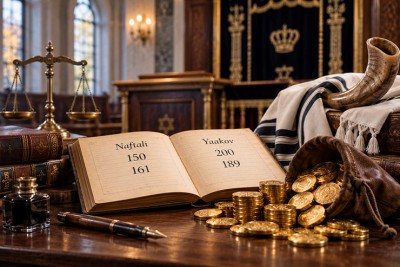
“Two days before Rosh Hashanah, we fasted and waited for some sign from Heaven. On the final night of the year, each of us had a dream revealing how much money we would earn during the coming year. When we met the next morning, we excitedly compared our dreams. Yaakov had seen that he would earn two hundred gold coins, while I had seen that I would earn only one hundred and fifty.
“We approached our Rav and told him about the fast and the dreams.
“‘If you will take my advice,’ the Rav told us, ‘record every bit of income you receive throughout the coming year, whether small or large.’
“We accepted the Rav’s advice and carefully recorded our earnings.
“One day, a serious dispute arose between us concerning merchandise we had purchased jointly and later sold at a handsome profit. When the time came to divide the proceeds, Yaakov maintained that our partnership had been formed on the understanding that all profits would be divided equally. I argued that because I had invested two-thirds of the purchase price while Yaakov had invested only one-third, the profits should be divided in the same proportion.
“We brought the matter before our Rav for a din Torah.
“‘Who currently has possession of the profit from the sale?’ the Rav asked.
“The money was in Yaakov’s possession.
“‘Do you have witnesses or a written agreement concerning the transaction?’
“We had neither.
“The Rav ruled that since Yaakov was in possession of the money, I would have to bring proof to support my claim. Since I had no proof, Yaakov would have to swear that his version was correct, after which he would be entitled to half the profit.
“But Yaakov refused to swear.
“‘What I am saying is completely true,’ Yaakov said, ‘but I am unwilling to take an oath. I will therefore forgo the additional profit that would come to me.’
“Yaakov took one-third of the profit and gave me the remaining two-thirds. The difference between our positions amounted to ten gold coins.
“We continued recording every bit of our income. A few days ago, as Rosh Hashanah approached, we took out our records and totaled everything we had earned.
“Yaakov had earned 189 gold coins—eleven fewer than the two hundred he had seen in his dream.
“I had earned 161 gold coins—eleven more than the one hundred and fifty I had seen in mine.
“We immediately came before our Rav and reported the totals. The Rav did not need long to consider the matter.
“‘It would seem,’ the Rav said, ‘that in your business dispute, Yaakov was correct. The profits should have been divided equally.’
“‘But the dispute involved only ten gold coins,’ I protested. ‘Why is the difference eleven?’
“The Rav had the answer.
“‘The additional gold coin was spent on the scribe who prepared the legal claim and the messenger who summoned you to the din Torah.’
“Still, I could not bring myself to accept the sudden loss of eleven gold coins, which was a substantial sum.
“‘I pay no attention to dreams,’ I said dismissively. To quiet my conscience, I added, ‘The Rav ruled according to Torah law, and I received the two-thirds honestly.’
“We returned to our shops to finish our preparations for Rosh Hashanah.
“Then something strange happened.
“Yaakov’s shop suddenly filled with customers, while not a single customer entered mine.
“By noon, Yaakov had earned exactly eleven gold coins. The moment he reached that amount, he closed his shop and went home.
“Angry and resentful, I also headed home. As I passed through the marketplace, I accidentally collided with the stall of a non-Jewish glass merchant, sending his merchandise crashing to the ground.
“The glassware shattered. The merchant beat me severely, and before long I was dragged before the court. The judge sent an appraiser to the marketplace to determine the value of the damage.
“The assessment was exactly eleven gold coins.
“I arrived home bruised, humiliated, and poorer by eleven gold coins.
“At that moment, I understood that our Rav had been right and that Hashem’s accounting was exact. Just last night, I went to the home of my friend Yaakov Abudarham and asked his forgiveness. Afterward, I came to our Rav and told him how the story had ended.”
Deeply moved, Naftali Azariah stepped down from the bimah.
The congregation had just heard how a dispute involving ten gold coins, together with one additional coin in expenses, had been accounted for down to the last coin. What had initially appeared confusing and even unfair had ultimately revealed an extraordinary precision.
Rav Yechiel then raised the shofar and began the order of the blasts.
On Rosh Hashanah, when we proclaim Hashem as King and stand before Him in judgment, this story carries a powerful message. We see only fragments of the picture. We may encounter events that seem unfair or impossible to understand. But Hashem sees the entire calculation.
“There is no injustice.”
Nothing is forgotten. Nothing is overlooked. And not even a single coin escapes the perfect judgment of Hashem.
Rabbi Leeor Dahan, a graduate of Yeshiva Chofetz Chaim/RSA, is a noted scholar and teacher, well-versed in halachah. He currently leads Kehilat Avodat Hashem in Hillcrest, Queens, inspiring his congregation to delve into Torah study and embrace its eternal teachings.
Perfect Judgment
Typography
- Smaller Small Medium Big Bigger
- Default Helvetica Segoe Georgia Times
- Reading Mode