


Faith After Unimaginable Loss, Raising Jewish Children, Preserving Bukharian Identity,
And A Life Spent Making A Difference
October 7 carries memories Rabbi Shlomo Nisanov cannot escape. He remembers the news three years earlier, Congresswoman Grace Meng arriving at his congregation in tears, and traveling to Israel 20 days later with a delegation of rabbis while three of his sons were living there. Ben Gurion Airport was nearly empty, and sirens were still sounding. But when Rabbi Nisanov sat down with Roman Kaykov on October 7, 2026, his family was also preparing for a bris. A grandson had just been born.
Roman asked how a person maintains faith after losing a child. “I don’t know why Hashem did not ask me, ‘Can I take your daughter? Can I take your youngest daughter?’” Rabbi Nisanov said.
Rachel Aliza a”h died following a jet ski accident. Rabbi Nisanov and his wife subsequently joined a group for parents who have experienced the death of a child, a group he would recommend to no one. The pain remains. “To hold on to the pain, to suffer with it — that’s a choice,” he said.
Rabbi Nisanov had experienced premature loss before. His father died at only 54. But this was his daughter. Rabbanim who comforted the family spoke of Rachel Aliza as a special neshamah who had completed her mission in this world. Rabbi Nisanov also drew strength from King David, who, after the death of his child, recognized that the child could not return to him, but one day he would go to the child.
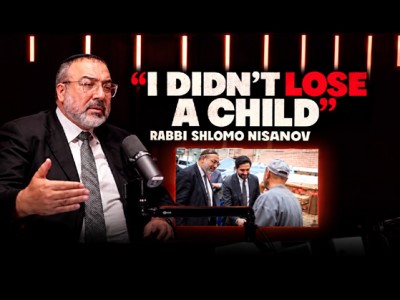
Then someone asked Rabbi Nisanov how many children he had. Eight, he answered. But hadn’t he lost one? “I didn’t lose a child.” As he explained to Roman, people lose money, sanity, or weight, but a child who dies does not stop being your child.
Rabbi Nisanov remains the father of eight: seven children here and Rachel Aliza a”h, whom he believes is with those in his family who have already left this world. “We brought her into this world,” he said, “and we got her pure and we returned her pure.” For Rabbi Nisanov, faith did not provide an explanation for what happened; it gave him and his wife a way to remain parents to their other children, serve their community, celebrate grandchildren, and continue living while carrying their daughter with them.
Rabbi Nisanov has been serving as a rabbi for 36 years. He entered the rabbinate in 1990 at only 19, after beginning to speak publicly at 16. His mother was the oldest of ten children, his father the youngest of seven, and he traces his family’s rabbinic lineage through generations, by family tradition reaching back to 1645.
His father gave him straightforward advice: If you want to become a millionaire, don’t become a rabbi. But make a difference in people’s lives. He also told his son to “leave a legend behind you” — to leave evidence that someone was helped because you were here.
His father’s influence emerges repeatedly in Rabbi Nisanov’s memories. Soon after the family arrived in America from the Soviet Union in 1980, young Shlomo brought home a test with a score of 30. His father refused to sign it, crumpled the paper, and threw it down. “I don’t have a stupid child,” Rabbi Nisanov remembers his father telling him.
Shlomo returned to school with the crumpled test and asked for another chance. He scored 95. This time his father signed it. “Words can build; words can destroy,” Rabbi Nisanov told Roman. What parents repeatedly tell a child can become part of how that child sees himself.
Rabbi Nisanov learned another lesson about identity in the Soviet Union. As a first grader, he recalled being denied the highest school grade because, as he understood it, he was Jewish. Other children received recognition he believed he had earned. He went home angry and asked his mother why he needed to be Jewish.
Today, he wants Jewish children to grow up proud of the identity he once questioned. “You have to start with yourself,” he said. Parents can lecture about Judaism, but children watch how their parents live. Is Torah real in the home? Are their parents honest? Are they proud to be Jewish and Bukharian?
Rabbi Nisanov believes assimilation is among the greatest challenges facing Jewish families in America because identity can disappear without anyone explicitly rejecting it. He wears his Bukharian kippah and traditional clothing proudly. Once his children were old enough to make their own choices, he did not believe endless instructions would keep them connected. He wanted them to see what their parents considered real.
“Don’t confuse Jews with Judaism,” Rabbi Nisanov told Roman. Jews can fall short. Judaism still demands that a person create a kiddush Hashem, treat others properly, and make a positive difference.
In marriage, Rabbi Nisanov emphasized two qualities: flexibility and commitment. Young people can approach dating with a rigid picture of whom they expect to find, but neither spouse remains exactly the person who stood beneath the chuppah. A lasting marriage requires two people willing to change and still build together.
When Roman asked what makes the Bukharian Jewish community distinctive, Rabbi Nisanov compared the Jewish people to an orchestra. If everyone played the same instrument, there would be no orchestra. Each Jewish community contributes its own sound. He pointed to Bukharian customs surrounding mourning, marriage, and remembering the destruction of the Beit HaMikdash as traditions carried across generations. Bukharian identity, he insisted, cannot be reduced to plov and samsa.
“We value tradition. We value where we come from, and we value our kids.” He wants those children to understand something else: “You are G-d’s gift in this world.”
Some people discover their purpose early; others take longer. Rabbi Nisanov found much of his in serving others, including through the Kehilat Sephardim Food Pantry, which for decades has distributed food to New Yorkers across religious and ethnic lines.
That work also explains one of the more controversial episodes of his recent communal life. Mayor Zohran Mamdani’s September visit to the pantry generated considerable discussion among Ashkenazic and Bukharian Jews troubled by the mayor’s positions and rhetoric concerning Israel. Rabbi Nisanov had known Mamdani since his years in the State Assembly, had challenged him directly over Israel, and had not supported him in the mayoral election. Before receiving the sitting mayor at the pantry, Rabbi Nisanov consulted his daas Torah. Mamdani came to distribute food, not address the congregation.
Hospitality did not prevent confrontation. Rabbi Nisanov recalled his mother speaking directly to Mamdani. “Mr. Mamdani, you’re not antisemitic.” According to Rabbi Nisanov, Mamdani responded, “Of course I’m not.” Then came her challenge: “Your words and your actions don’t mix.”
Rabbi Nisanov himself has challenged Mamdani over Eretz Yisrael, but he does not believe disagreement requires abandoning communication. “Let’s work [on] what unites us more than what divides us,” he told Roman.
For Rabbi Nisanov, knowing elected officials matters when a family has a problem, an institution needs assistance, or someone needs a door opened. The relationship has value when somebody can be helped.
Following October 7, Rabbi Nisanov also spoke at the Jamaica Muslim Center, where he faced difficult questions about Israel and Gaza. He made clear that he did not represent the Israeli government while refusing to distance himself from Israel. He worries that being anti-Jewish or anti-Israel has become, in his word, “fashionable,” but continues entering rooms where difficult conversations can take place.
Roman saved one question for the end: When people look back at his life, what does Rabbi Nisanov hope they remember — not about the rabbi, but about Shlomo Nisanov? “I want people to remember that we made a difference.”
His father had taught him that lesson, and Rabbi Nisanov has tried to pass it to his children. On the morning of this interview — October 7, a date carrying so much Jewish grief — his family was preparing for the bris of a new grandson. Rabbi Nisanov remains the father of eight children. Another generation has begun. Mazal Tov!
DAVID MAVASHEV is a mathematician, technology entrepreneur, and founder of Nastel Technologies. Born in Dushanbe, he studied mathematics in the Soviet Union before immigrating to Israel, where he worked, taught, continued his studies, and served in the Israeli military. He later moved to the United States and built a career in software and technology. His interests also include Jewish thought, Bukharian history and culture, Shashmaqam, and preserving family and communal history.
ROMAN KAYKOV is president of Kaykov Media and host and senior producer of KAYKOV TV. Through Kaykov TV, Roman sits down with rabbis, educators, business leaders, artists, and community figures for conversations about Jewish life, Bukharian identity, family, culture, faith, business, and community.
Rabbi Shlomo Nisanov: “I Didn’t Lose A Child”
Typography
- Smaller Small Medium Big Bigger
- Default Helvetica Segoe Georgia Times
- Reading Mode