

Bukharian Leadership, World Likud, Political Responsibility, And A Family Story Rooted In Zion
Two days before Israelis went to the polls, Roman Kaykov sat down with Yuriy Danielov to discuss elections, Israel, and a question that has shaped much of Danielov’s communal life: What responsibility does a Jew living thousands of miles from Israel still carry toward the Jewish state? Danielov did not hesitate. “Israel is strong, the diaspora is strong,” he told Roman. “Without a strong diaspora, there will be no strong Israel.”
An engineer who immigrated from Samarkand, Danielov serves in leadership with the All Bukharian Community Network and Emet Ve Emuna. His communal work has ranged from charitable initiatives to the long-running dispute at Mount Carmel Cemetery, where Bukharian families reported sinking grave beds and cracking monuments. Danielov, whose brother is buried there, drew on his engineering background and prior experience with cemetery matters in Uzbekistan while pressing management for answers, involving elected officials, and seeking repairs and accountability.
Around 2020, Danielov began helping Israelis who had lived in America, served in the IDF, and continued returning for miluim. He helped raise support for equipment and connected them with the Bukharian community. The effort grew into a broader push to bring Bukharian Jews into Zionist institutions rather than limit their involvement to support from afar.
Danielov became part of the ZOA Coalition effort in the 2025 American Zionist elections. He was No. 12 on the slate; this author, Shabsie Saphirstein, was No. 29. The coalition won six World Zionist Congress seats, with its sixth and final seat securing representation for Chagit Sofiev Leviev. Danielov later held the No. 12 position on the valid U.S. World Likud delegation following a court ruling restoring the original order.
For Danielov, the significance extended beyond who received a seat. Bukharian Jews had entered institutions where they had rarely been represented. He recalled one supporter who spent four days trying to cast a ballot because the system repeatedly rejected the vote. “I am very grateful to such people,” Danielov said. One ballot may seem insignificant, but communal influence begins with people willing to keep trying.
Roman noted that most Israeli citizens abroad cannot simply enter an Israeli consulate and vote in a Knesset election. Danielov defended the reasoning, saying someone who has built a life elsewhere does not bear the consequences of Israeli political decisions in quite the same way as someone living there. Israelis choose Israel’s government; diaspora Jews can support soldiers, advocate with American officials, join Zionist institutions, strengthen Jewish organizations, and ensure their communities are represented.
Danielov’s political preferences were unmistakable. He strongly supported Israel’s right-wing bloc and praised Prime Minister Benjamin Netanyahu’s leadership during the war, Israel’s operations against Iran and other regional enemies, efforts to return the hostages, and Netanyahu’s handling of relations with the United States. “Don’t change horses in midstream,” Danielov said, arguing that changing direction before the work was finished carried serious risk.
Roman acknowledged the fierce opposition Netanyahu inspires. Danielov believes critics often judge individual decisions without fully accounting for the pressures of war, international criticism, the American alliance, and Israel’s internal divisions. He also values Netanyahu’s willingness to speak publicly about G-d, saying Jewish sovereignty should not become detached from Jewish identity.
Danielov’s Soviet upbringing also informs his politics. He believes many Russian-speaking Jews approach the political left with particular skepticism because they remember socialism as lived experience rather than theory. That does not describe every immigrant from the former Soviet Union, but it helps explain Danielov’s impatience with political apathy. “Don’t be passive,” he told listeners. “We need to get up and vote.”
He was especially animated about Israelis treating Election Day as a vacation. Vote first, he urged; the barbecue, beach, and beautiful weather can wait. Do not keep saying “later” until the polls close. His preference about how Israelis should vote was plainly partisan, but his appeal to participate was broader.
Danielov spoke admiringly of Mikhail Lobovikov, an Israeli reservist who, Danielov said, had served hundreds of days while continuing his work as an architect, professor, mentor, and educator. What impressed Danielov was not only Lobovikov’s military service, but his continued commitment to teaching and passing knowledge to younger people.
He also praised Morton Klein, longtime president of the Zionist Organization of America, as a diaspora leader willing to carry Israel’s case directly into American political life. Danielov himself uses public platforms, including KaykovTV and his own online presence, to discuss Israel and Bukharian communal concerns.
Danielov told Roman that his Zionism reaches much further back than contemporary organizations or elections. Both sides of his family carried deep Zionist roots. Two of his great-grandfathers were named Zion. One, he said, traveled to the Land of Israel three times. His family story also reaches into Sh’chunat HaBucharim, Jerusalem’s historic Bukharian Quarter, where relatives were connected with the early communal and commercial life of the neighborhood.
One of the interview’s most memorable lines came from that family history. “I am the grandson of a Palestinian,” Danielov said. His grandmother, he explained, was born in Mandatory Palestine before the establishment of the State of Israel. His point was historical: His family’s Jewish connection to the land did not begin in 1948.
His ancestors traveled there, his grandmother was born there, and Bukharian Jews helped establish Jewish communal life there. Later generations built lives elsewhere, but the connection remained. “We, being in America, are worried about you,” Danielov told Israelis. “We will really root for you and vote for you with all our hearts.”
Danielov believes Israelis should choose the government whose decisions they live with, while diaspora Jews carry different responsibilities: support Israel, advocate in their own countries, strengthen Jewish institutions, help those serving, vote at home, and ensure their communities are represented in decisions affecting the Jewish world.
His own record reflects that approach. Years before discussing World Likud with Roman, Danielov was pressing for answers over damaged graves at Mount Carmel Cemetery. Later came support for reservists, the Zionist elections, and World Likud. The settings changed, but Danielov continued stepping forward when he believed his community needed representation or action.
The Zionist election results mattered even though Danielov did not personally receive one of the ZOA Coalition’s six World Zionist Congress seats. Neither did this author. Sofiev Leviev did, giving the Bukharian community representation at the Congress, while Danielov continued his involvement through World Likud. The value of the effort was not that every participant received a title, but that the community had entered the arena.
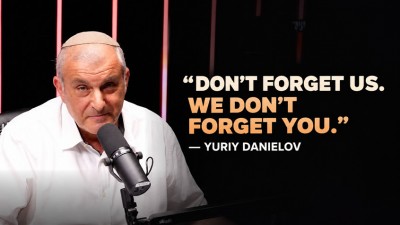
As the interview drew to a close, Danielov’s message to Israelis became more personal than political. “Don’t forget us,” he said. “We don’t forget you.” His family once expressed Zionism by traveling to the Land of Israel and helping build Jewish life there; his generation uses elections, advocacy, communal organizations, media, and the institutions of American Jewish life. His opening thought had become the thread running through the conversation: “A strong Israel, a strong diaspora.” For Yuriy Danielov, one depends on the other.
DAVID MAVASHEV is a mathematician, technology entrepreneur, and founder of Nastel Technologies. Born in Dushanbe, he studied mathematics in the Soviet Union before immigrating to Israel, where he worked, taught, continued his studies, and served in the Israeli military. He later moved to the United States and built a career in software and technology. His interests also include Jewish thought, Bukharian history and culture, Shashmaqam, and preserving family and communal history.
ROMAN KAYKOV is president of Kaykov Media and host and senior producer of KAYKOV TV. Through Kaykov TV, Roman sits down with rabbis, educators, business leaders, artists, and community figures for conversations about Jewish life, Bukharian identity, family, culture, faith, business, and community.
Yuriy Danielov: “A Strong Israel, A Strong Diaspora”
Typography
- Smaller Small Medium Big Bigger
- Default Helvetica Segoe Georgia Times
- Reading Mode