


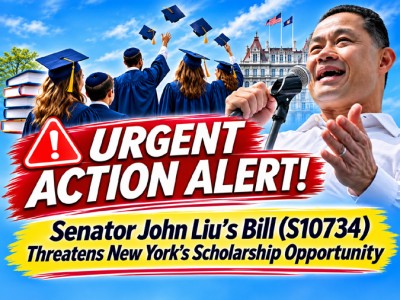
When tuition bills arrive alongside the mortgage or rent, groceries, and other expenses, even a modest scholarship can make a difference. Queens parents who welcomed New York’s decision to take part in a new federal scholarship program now face uncertainty over whether that opportunity will continue beyond 2027.
State Senator John Liu, who represents portions of Queens, including parts of Kew Gardens Hills, has introduced legislation that would change who decides whether New York stays in the program. The consequences could extend to public and nonpublic school families throughout the state.
The Federal Scholarship Tax Credit was set up under Section 25F of the Internal Revenue Code by legislation enacted July 4, 2025. States must choose to take part and find eligible Scholarship Granting Organizations (SGOs). These nonprofit organizations collect qualifying donations and award scholarships for educational expenses, which may include tuition, tutoring, textbooks, educational technology, and certain special education services.
Beginning in 2027, qualifying donations may earn a nonrefundable federal tax credit of up to $1,700 per eligible taxpayer. Unused credit may be carried forward for five years. The credited amount cannot also be deducted as a charitable contribution, and donating does not guarantee a scholarship for one’s own child.
Students eligible for public elementary or secondary school may qualify if household income is no more than three times the area median gross income, adjusted for family size. That could bring aid within reach of Queens families who do not ordinarily qualify for scholarships. Individual organizations may set narrower requirements. Qualifying awards are excluded from federal gross income.
Jewish educational organizations have pursued tuition assistance for years. In 2015, Agudath Israel of America, the Orthodox Union, and UJA-Federation supported the proposed Parental Choice in Education Act under Governor Andrew Cuomo. That effort focused on state-level tax assistance. The new federal program instead relies on private donations supported through federal tax credits, with states deciding whether to participate.
Governor Kathy Hochul opted New York into the federal program. Supporters welcomed the prospect of new educational assistance without a direct appropriation from existing public-school budgets. Critics have raised concerns about lost federal tax revenue, accountability, and the use of tax incentives for private education.
Liu introduced S10734 on November 9, with State Senators Jabari Brisport, Robert Jackson, and Liz Krueger as co-sponsors. The bill, which is still in the Senate Rules Committee, would give the Board of Regents sole authority over participation and approval of scholarship organizations beginning in 2028.
In the sponsor’s memorandum, Liu describes the program as a voucher program and argues that the Regents should oversee the decision because of their statewide education responsibilities. Agudath Israel strongly opposes the proposal, warning that future participation could be jeopardized if the Regents choose not to continue. The bill would not itself cancel the program for 2027 or require the Regents to withdraw in 2028. It would transfer decision-making authority, leaving future participation dependent on the board’s decision.
Meanwhile, on November 16, Hochul announced the opening of New York’s application process for scholarship organizations. Eligible nonprofits are encouraged to apply by December 31 for the 2027 program year. This is an important distinction: the state is actively preparing for participation even while Albany debates who should control the program in future years.
The IRS reproduced temporary and proposed regulations in its November 23 bulletin. The temporary rules, originally published October 2 and effective December 1, establish procedures for state participation, scholarship organization reporting, and donor acknowledgments. Broader proposed rules remain subject to public comment through December 1, with a hearing scheduled for December 15. Among the proposed provisions is a combined credit of up to $3,400 for qualifying married couples filing jointly if both spouses make eligible contributions.
Parents cannot apply through the state’s current portal: it is for scholarship organizations. Those organizations will establish their own application procedures and award amounts. Until then, families should not count on a particular reduction in tuition.
Agudath Israel urges residents to contact Liu and request that S10734 be withdrawn. The senator’s office can be reached at 718-765-6675 or This email address is being protected from spambots. You need JavaScript enabled to view it.. The organization’s action alert is available at https://agudah.org/action-alert-urge-senator-john-liu-to-protect-the-federal-scholarship-tax-credit.
Queens Families Face Uncertainty Over Federal Scholarship Program Under Liu Bill
Typography
- Smaller Small Medium Big Bigger
- Default Helvetica Segoe Georgia Times
- Reading Mode