


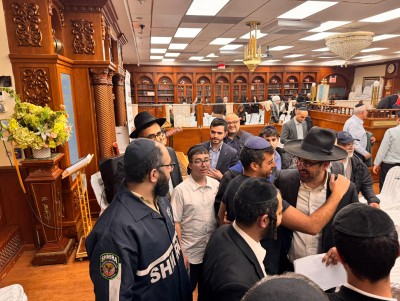
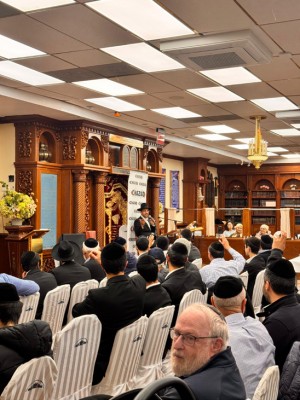

Rav Meir Eliyahu, shlit”a, returned to Queens on Thursday evening, May 7, bringing with him the warmth of a familiar Torah voice and the urgency of a leader speaking to a generation under pressure. At Beth Gavriel Community Center in Forest Hills, a Chazaq lecture billed as “End Of Days” quickly became something more intimate: a call to strengthen the Jewish home, the marriage, and the child before Mashiach arrives.
The crowd, drawn from across the Queens Jewish community, arrived expecting to hear about troubling headlines and the final era before redemption. What they received instead was a mirror held up to the choices being made inside their own four walls.
For Rav Eliyahu, the evening felt like a homecoming. The sought-after speaker opened by saying how meaningful it was to return to New York, and specifically Queens, where his live teachings first began making an impact roughly 20 years earlier in Jamaica Estates. Since then, his path has taken him through Florida and Eretz Yisrael, before returning to Queens as one of today’s most recognizable Torah lecturers.
With familiar honesty, Rav Eliyahu admitted to the crowd that the situation felt a bit “awkward.” The flyer promised a deep dive into the end of days, but the noted lecturer had arrived prepared to speak on a different crisis: marriage. Rav Eliyahu explained that with so many people today struggling with shidduchim, parenting, finances, and inner confusion, the Jewish home felt urgent. Rather than ignore the advertisement, Rav Eliyahu let the audience vote. The hands went up for the advertised topic.
That vote framed the rest of the night. Rav Eliyahu accepted the decision but refused to leave marriage behind. Instead, the speaker bridged the two themes, showing that they are deeply connected. The pressures bearing down on Jewish families today are part of the challenges of the generation before Mashiach. The end of days is not only about wars, headlines, dates, and signs. It is about the spiritual health of our homes and our ability to remain connected to Hashem when the world feels like a whirlwind.
Pointing to the pressures on modern families, Rav Eliyahu revisited the familiar saying that “the apple doesn't fall far from the tree.” Today, the lecturer noted, the winds are so unusually strong that even the best trees need extra bracing. Good homes need protection, guidance, warmth, and connection. In an era where the cost of living breeds constant anxiety, Rav Eliyahu reminded the crowd that while the body needs food and the car needs gas, the soul needs Torah. Without it, a person may look alive on the outside while withering within.
The heart of the lecture centered on shalom bayit. Drawing from the Midrash, Rav Eliyahu spoke of how HaKadosh Baruch Hu is yoshev u’mezaveg zivugim — constantly involved in arranging matches. Marriage, the rav explained, is not a one-time pairing that takes care of itself. It requires ongoing Divine wisdom, patience, and effort. A Jewish home does not survive simply because a couple stood under a chupah; it survives because the Shechinah is invited in daily.
Rav Eliyahu painted a vivid, often humorous picture of couples who are both giving, both frustrated, and both convinced the other does not understand them. One spouse gives “tomatoes,” while the other desperately needs “cucumbers.” The giver feels unappreciated — “I am doing so much!” — while the receiver remains hungry because the actual need was never addressed.
The takeaway was blunt: Love is not measured by what a person thinks is being given. Love means learning the language of the other.
“Don’t try to live with another person with your language,” Rav Eliyahu urged. What makes one spouse feel appreciated may not be what makes the other feel secure. What one calls love, the other may not even recognize. Without real conversation, resentment grows in the silence. With honest conversation, a home can be rebuilt.
The practical advice was a lifeline for many in the room: stop trying to solve arguments in the heat of the moment. Fighting is the worst time to fix a marriage. Instead, couples should set aside time every week or two to go out together — not just for a meal, but to work on the relationship. Each spouse should calmly share what is bothering them, away from the storm of the moment, and look for solutions together. Rav Eliyahu said plainly that people who followed this advice later reported that it saved their marriages.
The message turned even sharper when the lecture moved to parenting in the smartphone age. Children, Rav Eliyahu warned, remember their parents in the positions they see them most. If a parent is constantly scrolling or emotionally elsewhere, that image becomes part of the child’s core memory of home. Parents must be present during the anchor moments: when children wake up, when they leave for school, when they come home, and when they go to sleep. A child needs a hug, a smile, a “we missed you,” a “how was your day,” and a parent who puts the phone down long enough to show that the child matters.
Rav Eliyahu also warned against the trap of mixed messages. A parent cannot preach against lashon hara while a child hears improper speech at home. Children are not shaped by slogans. They are shaped by what they see and hear every day.
The room laughed often as Rav Eliyahu used relatable anecdotes — wedding scenes, Shabbos table dynamics, and the absurdity of human ego — to drive the points home. But the humor never masked the gravity of the warning: the generation is struggling because homes are struggling, and homes are struggling because people have forgotten how to think deeply about someone other than themselves.
Marriage, Rav Eliyahu explained, begins when a person stops asking only, “Who will fit me?” and starts asking, “Whom can I build? Whom can I give to? Whom can I understand?” The breaking of the glass under the chupah, the rav said, reminds a person that selfishness must be shattered to make room for another.
As the evening drew toward its close, Rav Eliyahu circled back to the advertised question: When will Mashiach come, and how should a Jew prepare?
Rav Eliyahu cited sources from the Ramban, Rabbeinu Bachya, and the Zohar regarding the final stretch before the end of the sixth millennium. Several calculations were mentioned — some speaking in terms of 14 years, others eight, others four — while the central emphasis remained that Mashiach can come earlier at any moment. The purpose was not panic or obsession with dates. It was responsibility. Time is precious. The world is moving. A Jew has to be ready.
Readiness, Rav Eliyahu made clear, is not built through fear.
Quoting the Gemara in Sanhedrin, Rav Eliyahu reminded the audience that one who wishes to be spared from the difficult birth pangs before Mashiach should involve himself in Torah and gemilut chasadim. Torah and kindness are not abstract ideals. They are the practical tools for spiritual survival.
Rav Eliyahu then praised Chazaq for its tireless work in spreading Torah, strengthening communities, and bringing inspiration not only to Queens but across America. The audience was encouraged to support and strengthen that work, which Rav Eliyahu described as both Torah and gemilut chasadim — the very formula Chazal give for navigating the final era before redemption.
The evening also reflected why Rav Eliyahu has become such a widely followed Torah voice. A baal teshuvah himself, Rav Eliyahu is known for speaking to Jews across levels — from seasoned Torah scholars to those searching for a stronger connection to Torah. His shiurim reach audiences in Eretz Yisrael and around the world, weaving together sources from Chazal, practical guidance, humor, and personal stories. The rav's published works include writings on the weekly parashah and responsa-style discussions across the four sections of Shulchan Aruch, while his lectures are known for a remarkable command of sources, often delivered with energy and fluency without notes or open books.
For the Queens community, the message was clear: waiting for Mashiach is not passive. The end of days is not merely a countdown on a clock. It is a question of what kind of people we are becoming, and what kind of homes, families, and communities we are building, while we wait.
By Shabsie Saphirstein
Rav Meir Eliyahu Returns To Queens With A Fiery Message: The End Of Days Begins At Home
Typography
- Smaller Small Medium Big Bigger
- Default Helvetica Segoe Georgia Times
- Reading Mode