


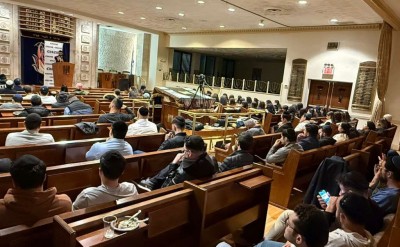

Walking into a room full of strangers with a mix of hope, nerves, and uncertainty is an experience familiar to many singles. On Tuesday evening, May 12, Chazaq Connections, R&N Matchmaking, and Milana's Private Events helped ease that tension with a warm “Mocktails & Mingling” event for singles in their 30s and 40s at the Young Israel of Hillcrest.
The evening offered guests a dignified, relaxed setting to meet and converse. With a hot buffet, colorful mocktails, live entertainment, and a welcoming atmosphere, participants were able to mingle naturally. Held in memory of Imashalom bat Bityo, the program reflected Chazaq’s ongoing commitment to strengthening Jewish connection at every stage of life. The gathering featured words of Torah and practical guidance from Rabbi Yisrael Yakubov of Toronto, who addressed the crowd on “The Clarity Protocol For Singles”.
Rabbi Yakubov shared that he had originally been scheduled to speak in Canada that evening, but rearranged his plans specifically because this gathering was for singles. Citing Rabbi Nachman of Breslov’s focus on the younger generation, Rabbi Yakubov emphasized that singles and young couples represent the future of Klal Yisrael, and helping them build proper homes is a vital communal responsibility.
The Gemara teaches that Hashem is “yoshev u’mezaveg zivugim,” involved in making matches. Rabbi Yakubov explained that matchmaking means connecting things that genuinely belong together. When people help others find their match, or learn how to approach marriage with greater seriousness, they emulate Hashem.
Acknowledging the different religious backgrounds in the room, Rabbi Yakubov did not give the same answer for everyone. Instead, he encouraged each person to think honestly about what they are looking for, what kind of home they hope to build, and which values must be shared for that home to succeed. He then addressed one of the most difficult parts of dating: doubt.
What made Rabbi Yakubov’s message especially relatable was that he did not minimize the difficulty of dating. He acknowledged the uncertainty that many singles feel after a date: Should I continue? Am I being too picky? Am I ignoring something important? Rather than adding pressure, he offered a calmer way to think — separating real concerns from distractions and helping singles focus on the qualities that actually build a home.
Recognizing True Spiritual Depth
For those seeking a Torah-observant spouse, Rabbi Yakubov noted that outward appearance alone is not enough. A kippah, a beard, or a specific look can be cultural indicators, but they do not reveal a person’s inner world. A more reliable way to gauge someone’s spiritual seriousness, he said, is to notice how they make brachot and how they daven.
A person who rushes through a brachah, or looks around constantly while davening, may be revealing a distracted inner life. Someone who slows down, pauses, and speaks to Hashem with sincerity reveals something deeper. Quoting the Arizal, Rabbi Yakubov explained that careful, focused brachot and t'filot are among the ways a person becomes spiritually elevated.
Generosity, Warmth, & Ayin Tovah
Rabbi Yakubov then turned to the traits to look for when dating. A man, he said, was created to be a giver — a role expressed under the chuppah, when he gives the ring. A husband’s mission is to provide, support, and bring happiness into the home. Therefore, a key trait a woman should notice in a man is whether he gives generously, both financially and emotionally.
He cautioned against stinginess, calling it a serious concern when it appears as a pattern. He shared the example of a man in Israel who stopped a taxi several blocks short of the hotel lobby where he and his date planned to sit, seemingly to save a small amount of money. Rabbi Yakubov stressed that one isolated incident should not be judged too quickly, but a consistent pattern of avoiding giving should be taken seriously.
Citing Rabbi Pinchas of Koretz, a student of the Baal Shem Tov, he said that stinginess is among the most damaging character traits. Hashem gives constantly, and a person who wants to be close to Hashem must learn to give as well. For someone who struggles in this area, he cited the Rambam’s advice to train oneself through small repeated acts of giving, until generosity becomes more natural.
For a man looking at a woman, Rabbi Yakubov emphasized warmth, positivity, and connection. One simple sign is whether she laughs at his humor. If a man says something funny and the woman naturally smiles or laughs, it shows that they understand each other. If they cannot connect in ordinary conversation, that gap may become more noticeable under the pressures of marriage. A couple must be able to enjoy each other’s presence.
Rabbi Yakubov also unpacked the Gemara’s teaching about a bride with “beautiful eyes.” This refers to an ayin tovah — the ability to see situations generously and focus on the good.
He gave the example of a date where a woman rejected a promising match simply because he took her to a dairy restaurant rather than a meat restaurant. To Rabbi Yakubov, the issue was not the restaurant; it was the way she viewed the situation. A person who immediately looks for what is lacking may struggle to build peace in a home, while someone with an ayin tovah brings calm, kindness, and trust into a marriage.
The Three-Date Road Map
To help singles navigate the early stages of dating, Rabbi Yakubov offered a practical structure.
The first date, he said, is the “identity” date. It is about learning basic background: family, upbringing, work, and general direction in life. During that stage, it is important to hear how a person speaks about parents and siblings. A healthy, respectful connection to one’s current family can be a strong sign of how that person will treat a future spouse.
The second date should explore compatibility. Do both people want the same kind of home? Are their spiritual goals aligned? Do they share similar values? Are they heading in the same direction?
The third date, he called the date of “kishkushim” — simple conversation. This is when a couple should see whether they can talk comfortably about ordinary things. Not every conversation needs to be serious. A couple must be able to speak naturally, laugh, and spend time together without tension.
Shared Values, Real Concerns, & What To Let Go
Rabbi Yakubov connected the importance of shared values to Avraham Avinu sending Eliezer to find a wife for Yitzchak from his own family, highlighting the benefit of a shared lifestyle and worldview. People from different backgrounds can certainly build beautiful marriages, but major gaps in lifestyle can create challenges.
Even within the same community, homes can feel very different. One may be loud and lively, while another is quiet and reserved. Neither is wrong, but a person must ask whether those two styles can realistically work together. The goal is not to find a copy of oneself, but someone whose way of living can blend into a shared home.
Rabbi Yakubov also warned against marrying for money. Citing the Gemara, he said that marrying primarily for wealth damages the family’s foundation. Money comes only from Hashem. He shared a story of a man in Moscow who married into a wealthy family and was divorced within a month, reminding listeners that wealth does not guarantee peace.
When addressing the question, “How do I know this is the one?” he cited the Ben Ish Chai’s explanation of binah yeterah, the deeper intuition given to women. If the essential questions are aligned, a woman’s inner sense can be a meaningful sign.
However, Rabbi Yakubov drew a clear line regarding spiritual gaps. A person should not take on a “project.” If someone wants a Shabbat-observant, kosher home, they should not enter marriage expecting to transform someone who is not currently living that way. There can be a large gap between what a person says during dating and what they are actually ready to sustain.
For non-spiritual concerns, he offered a simple rule: ask whether you can live with the person as they are right now, without imagining that you will later change their personality, habits, or appearance. Growth belongs in marriage, but acceptance must exist before it.
He urged singles not to confuse real concerns with minor distractions. A serious gap in religious worldview, values, or life direction deserves attention. But a style choice, aesthetic preference, or small personal difference should not erase good middot, sincerity, and compatibility.
Navigating Delayed Shidduchim
Speaking about delayed shidduchim, Rabbi Yakubov noted that while Kabbalistic sources indicate that some delays are connected to deeper spiritual processes, people can also miss opportunities by rejecting strong matches for shallow reasons. A beard style, curly hair, or minor aesthetic preference should not outweigh the qualities needed for a strong marriage.
He encouraged singles to have a trusted mentor to consult. A good adviser can help a person see whether a concern is a genuine red flag or a secondary detail driven by fear.
Spiritual Practices & Segulot
Toward the end of his remarks, Rabbi Yakubov shared several segulot and spiritual practices to bring merit to the dating process.
For men, he recommended being careful with Kiddush Levanah, the blessing over the new moon, and reciting it with joy each month. He also recommended learning Masechet Ketubot as a merit for finding a spouse.
For women, he suggested asking a father to have them in mind during Kiddush Levanah. He also cited a teaching from Rabbi Gershon Edelstein that accepting upon oneself to dedicate a bed in one’s future home for guests can serve as a merit for marriage, since hospitality is central to a Jewish home. He also mentioned the practice of lighting a candle for the Tanna Rabbi Matityahu ben Charash for 40 consecutive days, accompanied by personal prayer.
For everyone, he mentioned praying for one’s shidduch during rain, a time described as powerful for t'filah. He also noted that when two parashot are read together, the fourth aliyah, which connects the two readings, is spiritually tied to matching.
Finally, he shared a practice from Rabbi Mordechai Eliyahu, zt”l, for before a date: open T'hilim, read ten consecutive chapters from that point, recite a short prayer for Divine favor, and say the name of David HaMelech’s mother, Nitzvet bat Adael, 17 times. Success ultimately comes from Hashem, Who opens eyes and hearts at the right time.
Rabbi Yakubov concluded by blessing the singles with success, health, parnassah tovah, and a lasting zivug hagun. His message was practical, warm, and reassuring. Dating does not need to be driven by panic, fantasy, or outside pressure. With Torah values, self-awareness, good guidance, and trust in Hashem, singles can move forward with confidence, knowing that clarity is not about finding perfection. It is about recognizing the shared values, connection, and character needed to build a lasting Jewish home.
Never Marry A "Project": Crucial Advice for Modern Singles
Typography
- Smaller Small Medium Big Bigger
- Default Helvetica Segoe Georgia Times
- Reading Mode