


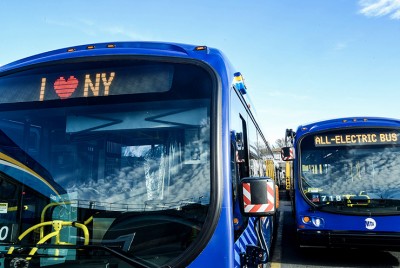
A newly announced plan intended to speed up bus service could bring additional changes to how residents park, make deliveries, reach shuls and schools, and travel through some of the busiest streets in Jewish Queens. Although detailed designs have not been released for most of the Queens corridors, future projects could affect curbside parking, loading zones, turning movements and traffic patterns along several heavily traveled neighborhood streets.
The New York City Department of Transportation and Metropolitan Transportation Authority have identified 50 citywide corridors for bus-priority improvements under a program called Next Stop: Fast Buses, Better Service. DOT and the MTA say they will advance 28 projects across the five boroughs during 2026, although that does not mean every corridor on the list—or every Queens corridor—will be redesigned this year.
Among the Queens corridors are 108th Street; Main Street and Linden Place; Kissena Boulevard, Union Street and Parsons Boulevard; Northern Boulevard; and portions of Woodhaven Boulevard, including the area between Union Turnpike and 107th Avenue. These streets carry some of the borough’s busiest bus routes, including the Q23 along 108th Street; the Q20 and Q44-SBS along Main Street; the Q17, Q20, Q25, Q27 and Q65 across portions of the Kissena–Union–Parsons corridor; the Q66 along Northern Boulevard; and the Q52-SBS and Q53-SBS along Woodhaven Boulevard.
The new initiative is separate from the Queens Bus Network Redesign implemented in 2025. That earlier project changed routes, stops, service patterns and frequencies, while the Next Stop program focuses primarily on possible street-level measures intended to help buses move more quickly.
The citywide goal is to increase bus speeds by 20 percent, shorten some trips by as much as six minutes and reduce delays at bus stops to less than two minutes beyond the scheduled wait. Faster and more reliable service would bring clear benefits, particularly in Queens neighborhoods where thousands of residents depend on buses to reach the E, F and 7 trains, the Long Island Rail Road, hospitals, shopping districts and government offices.
Reliable service is especially important for seniors traveling to medical appointments, students heading to school and commuters trying to reach work on time. Delays and missed buses can result in missed appointments, lost wages and difficult connections.
What remains unknown is which street changes will be required to achieve those faster trips. Bus-priority projects can include dedicated lanes, altered parking and loading areas, turn restrictions, redesigned intersections, changes to traffic-signal timing and camera enforcement.
The published plan identifies the corridors under consideration but does not provide a block-by-block design for most of the Queens streets. Residents therefore do not yet know precisely where bus lanes, parking changes, loading zones, turn restrictions or enforcement cameras may be proposed.
As individual projects advance, DOT posts designs, presentations and other information on its Fast Buses Projects and Design Toolkit page. Proposals are also frequently presented to the affected community board before implementation, although the timing and extent of public consultation may differ from project to project.
Residents may testify before a community board’s transportation committee or full board and request an advisory resolution supporting, opposing or recommending modifications to a proposal. Such resolutions are not binding on DOT, but they create a public record of neighborhood concerns and can provide elected officials with a basis for seeking changes.
Shuls, yeshivot, merchants and other institutions should not wait until installation begins. Once a proposal is released, they should request the exact number and locations of parking and loading spaces that would be affected, planned turning restrictions, enforcement hours, provisions for Access-A-Ride vehicles and school buses, and the deadline for submitting public comments.
A design that works on a broad commercial avenue may create serious problems on a narrower neighborhood street. Removing curb access near a grocery, pharmacy or restaurant can disrupt deliveries, while eliminating parking near a shul can make access more difficult for elderly congregants, people with disabilities and families with young children.
Poorly planned turn restrictions may also divert vehicles onto residential streets without materially improving bus operations. Each proposal must therefore be examined in the context of the particular street, nearby institutions and existing traffic patterns.
Leaving bus service unchanged carries a cost of its own. Double-parked vehicles, blocked bus stops and chronic congestion delay thousands of passengers, including many who have no practical alternative to public transportation. The discussion should not become a simple contest between drivers and bus riders. A carefully designed project may improve service while preserving necessary loading access, minimizing parking losses and preventing traffic from being pushed onto residential blocks.
DOT and the MTA say they will work with elected officials, community organizations and riders as individual projects are developed. Queens residents deserve clear data showing where the most serious bus delays occur, which measures are expected to produce meaningful improvements and how the agencies plan to balance faster transit with neighborhood commerce, school transportation and emergency access.
Shuls, yeshivot, merchants and residents should examine the corridor list now and monitor proposals affecting their neighborhoods. Local institutions know where elderly pedestrians cross, where delivery trucks stop and where traffic becomes particularly difficult before Shabbos and holidays. Once lane markings are painted, signs are installed and enforcement begins, modifying a project becomes considerably more difficult, making it essential to study the proposals and speak up while the designs are still being developed.
By Steven Saphirstein
Faster Buses Or Fewer Parking Spaces? Major Transit Plan Reaches Jewish Queens
Typography
- Smaller Small Medium Big Bigger
- Default Helvetica Segoe Georgia Times
- Reading Mode