


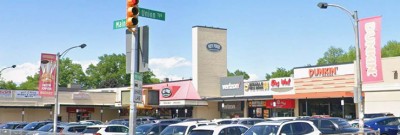
The death of a 61-year-old woman struck by a vehicle near Main Street and Union Turnpike has renewed concern about pedestrian safety at one of Kew Gardens Hills’ busiest intersections.
Wang Jing, who lived only blocks away, was crossing Union Turnpike shortly after 8 a.m. on Wednesday, August 26, when she was struck by a 2010 Honda Civic whose driver was making a left turn, according to police. She suffered severe head injuries and was transported to Jamaica Hospital Medical Center, where she was pronounced dead.
The 56-year-old driver remained at the scene. Police said the pedestrian had been crossing outside the marked crosswalk. No arrest had been announced, and the NYPD Highway District’s Collision Investigation Squad is investigating.
The location is familiar to thousands of neighborhood residents. Main Street and Union Turnpike carry heavy traffic throughout the day and serve numerous bus routes, stores, schools, professional offices and houses of worship. Drivers turn through wide lanes while pedestrians travel between bus stops and opposite sides of a commercial corridor that functions as the center of the community.
The circumstances of this collision remain under investigation, and responsibility should not be assigned before that work is completed. The fatality nevertheless underscores risks that residents confront daily: long crossings, turning vehicles, heavy traffic, limited time, distracted road users and pedestrians entering the roadway between designated crossings.
The approaching Yamim Nora’im make the concern especially timely. More residents will be walking to shul, including children, seniors and visitors unfamiliar with the intersection. Evening services will also place pedestrians on surrounding streets after dark.
Drivers should slow before turns, check crosswalks and corners in both directions and anticipate that a pedestrian may be present even when the signal appears clear. A green light permits movement; it does not eliminate the obligation to yield safely.
Pedestrians should use marked crossings whenever possible, obey signals and avoid assuming that a turning driver has made eye contact. Reflective items are particularly valuable after dark, but visibility does not replace caution from motorists.
City transportation officials should review the intersection’s signal timing, turn patterns, lighting and pedestrian visibility in light of the fatality. Enforcement and education can help, but street design also determines how likely an ordinary mistake is to become irreversible.
One death is not merely another entry in city statistics. It represents a neighbor who left home on an ordinary morning and never returned. The appropriate response is neither speculation nor blame, but a careful investigation and concrete attention to whether this heavily traveled intersection can be made safer.
By Shabsie Saphirstein
Fatal Union Turnpike Crash Renews Concern Over Pedestrian Safety
Typography
- Smaller Small Medium Big Bigger
- Default Helvetica Segoe Georgia Times
- Reading Mode