


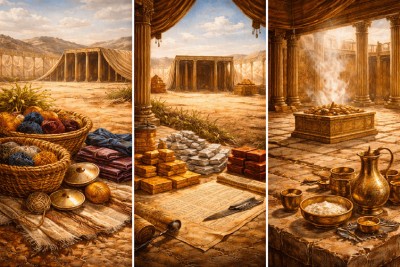
“A sacrifice begins with thought, continues with words, and ends with action — the same path by which sin itself is formed.”
The Book of Vayikra introduces the complex system of offerings once brought in the Holy Temple.
To modern readers these laws may seem distant or even mysterious. Animals are brought to the altar, their blood sprinkled, portions burned, and other parts eaten by the Kohanim.
Why such a system?
The Ramban offers a powerful psychological explanation.
Every human action unfolds in three stages:
First comes thought.
Then speech.
Finally action.
When a person sins, this same process occurs. The idea forms in the mind, it is justified in words, and eventually it becomes a deed.
The sacrificial service reverses this process.
A sinner brings an offering to the Temple — acknowledging the wrong in thought.
He confesses verbally before Hashem — correcting speech.
Then the animal is slaughtered — confronting the seriousness of the act in physical reality.
Watching the offering burn on the altar forces a person to reflect deeply. “My anger burned like this. My impulses led me here.”
The experience leaves a lasting impression.
The different offerings reflect different spiritual situations.
The Olah — the burnt offering — is completely consumed by fire. Nothing remains. It represents opportunities for good that were neglected, moments when a person could have acted but did not.
The Shelamim, or peace offering, expresses gratitude and joy. Its meat is shared with family and friends, transforming personal happiness into communal celebration.
The Chatas atones for unintentional sins, reminding us that mistakes happen even when intentions are good.
The Asham addresses certain types of wrongdoing and restitution.
Each offering reflects a different dimension of human experience.
But today we face a difficult reality: the Temple no longer stands.
How, then, can we fulfill these laws?
The Prophet Hoshea provides the answer:
“Let our lips replace the bulls.”
Prayer and study take the place of sacrifice.
The Chofetz Chaim once explained that studying the laws of the Temple service is considered by Hashem as if we are participating in that service ourselves.
The Midrash adds an extraordinary teaching.
Whether a person offered a large bull, a bird, or even a small flour offering, the Torah repeats the same phrase:
“A pleasing fragrance before Hashem.”
Why?
Because Hashem measures the heart, not the size of the gift.
One person may give a thousand coins easily.
Another may struggle to give one.
In Heaven, their offerings may weigh exactly the same.
Parashat Vayikra is sponsored by Oleg & Margarita Fuzaylov
Parashat Vayikra: The Meaning of Sacrifice
Typography
- Smaller Small Medium Big Bigger
- Default Helvetica Segoe Georgia Times
- Reading Mode