


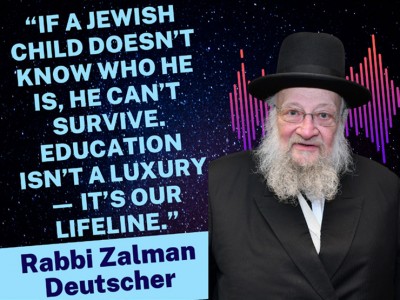
When Rabbi Zalman Deutscher speaks about Jewish survival, it isn’t theoretical. It’s personal. It’s historical. And it’s rooted in lived reality — stretching back generations and carried forward through decades of quiet, determined work.
Rabbi Deutscher grew up hearing stories of Jewish life in Providence, Rhode Island, at a time when observance was fragile and Jewish continuity was anything but guaranteed. Tens of thousands of Jews lived there at the turn of the twentieth century, yet by mid-century only a handful still observed Shabbat. Yeshivot didn’t exist. Public school was the only option. Survival depended almost entirely on what a family chose to fight for.
He remembers relatives walking long distances on Shabbat to avoid exposure to open stores, parents working six days a week just to put food on the table, and grandparents who lost job after job because they refused to compromise their faith. Many meant well. Many tried. But without education, the chain quietly broke.
And Rabbi Deutscher saw what happened next.
When There Is No Foundation
Families who relied solely on afternoon Talmud Torah programs, he explained, often watched their children — and especially their grandchildren — drift away entirely. Even those who were “Yeshiva-lite,” as he described it, couldn’t withstand the pressures of the outside world without a firm grounding in who they were and what they stood for.
That realization shaped everything that came later.
When his own family moved to Brooklyn so he could attend Yeshiva, Rabbi Deutscher encountered students who had traveled days by train just to learn Torah. Some came from Los Angeles. Others from homes where Judaism was barely visible. The ones who endured were not necessarily the most gifted — they were the ones who had roots.
That lesson never left him.
Why Yeshiva Is Not Optional
When Rabbi Deutscher later helped build what became Yeshiva Primary / Yeshiva Institute, the vision was clear: Jewish education had to begin early, be comprehensive, and be affordable.
“You can’t balance a chair on one leg,” he would tell parents. “If a child grows intellectually but remains a spiritual first-grader, he will eventually topple.”
General studies mattered deeply to him. Smaller classes, accountability to parents, and serious academic standards were non-negotiable. But without Yiddishkeit growing alongside them, children were being set up to fail — not immediately, but inevitably.
The goal was never isolation. It was confidence.
A child who knows who he is doesn’t need to tear others down to feel strong. A Jewish education, Rabbi Deutscher argued, doesn’t create bigotry — it creates security.
Making Education Possible
One of Rabbi Deutscher’s most consistent battles was financial. He insisted tuition remain within reach, even when it cost the school more than it charged. Parents needed to feel that Yeshiva was possible — not something reserved for others.
Time and again, families who hesitated returned year after year, sending second and third children once they saw both the academic results and the personal growth. Over decades, the outcomes spoke for themselves: doctors, lawyers, pharmacists, educators, business owners — Jews who remained connected and capable.
Not perfect. But present.
And that, he believed, was survival.
Survival Is Everyone’s Responsibility
“Kiruv isn’t for professionals only,” Rabbi Deutscher said plainly. “Every one of us can help.”
An hour of time. A name. A quiet conversation. A referral.
He urged families to think about neighbors, coworkers, relatives with children in public school — not to pressure, but to offer options. Often, parents weren’t opposed to Jewish education; they simply didn’t know what existed or believed it was out of reach.
Survival doesn’t happen through speeches alone. It happens through relationships.
Reconnecting, Not Reinventing
In one of the most powerful moments of the conversation, Rabbi Deutscher compared today’s generation to a severed telegraph cable — temporarily disconnected, not lost. The task now isn’t to chart a new course, but to reconnect to what once flowed naturally.
“Our grandparents did the best they could,” he said. “The circumstances were impossible. We’re not rejecting them — we’re finishing what they started.”
That perspective reframed everything: immigration, disruption, Communism, cultural pressure. What looked like abandonment was often survival under fire.
Now, the responsibility rests with us.
Survival For All
Rabbi Deutscher’s message was not dramatic, but it was urgent. Jewish survival doesn’t belong to institutions alone. It belongs to communities. Families. Individuals willing to care enough to act.
Education is not a luxury.
It is the bridge between generations.
And without it, nothing else holds.
Rabbi Yaniv Meirov is the mara d’atra of Kehilat Charm Circle in Kew Gardens Hills and serves as Chief Executive Officer of Chazaq.
Now 222 episodes strong, Chazaq Torah Talks continues to inspire by showing that Jewish growth and survival are shaped through lived experience, commitment, and connection.
Rabbi Zalman Deutscher – Survival For All
Typography
- Smaller Small Medium Big Bigger
- Default Helvetica Segoe Georgia Times
- Reading Mode