


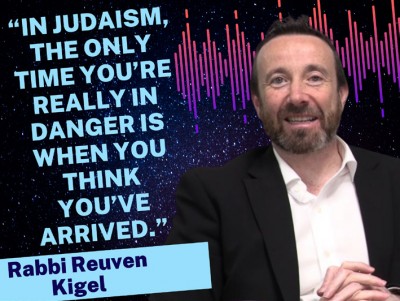
This sharp warning from Rabbi Reuven Kigel sets the tone for a profound reality check facing the modern Jewish community. Speaking on Chazaq Torah Talks, Rabbi Kigel suggested that the greatest threat to spiritual continuity today is not overt hostility toward Torah life—it is simple, quiet distraction. A person can be intensely busy, outwardly successful, and highly entertained, yet slowly lose their connection to a deeper life purpose without even realizing it.
For many Bukharian and Russian-speaking Jews across Queens and beyond, the opening chapters of Rabbi Kigel’s personal journey hit remarkably close to home. Born in Kiev, Ukraine, he immigrated to America as a young child and grew up in a traditional but largely disconnected New Jersey environment. Like so many families who emigrated from the former Soviet Union, they possessed an unshakeable Jewish pride and identity, but very limited access to formal Torah knowledge. Judaism was something fiercely inherited on an emotional level, but not yet understood intellectually.
That dynamic shifted dramatically after a severe car accident involving his father awakened deep, existential questions within the household. Rabbi Kigel recalled the pivotal moment he sat down with an ArtScroll Chumash, turning to the prophetic sections of Sefer Devarim that outline the trajectory of Jewish exile, persecution, miraculous survival, and ultimate return.
His reaction to the text was analytical before it was emotional. “With my Russian mathematical brain,” he joked, “I couldn’t ignore it.”
How could an ancient text predict thousands of years of volatile Jewish history with such flawless, mathematical precision? The conclusion became unavoidable: the Torah was Divine. That realization transformed his life, though he is quick to note that real change demands patience. “Nobody becomes the Baba Sali overnight,” he smiled. “Yiddishkeit is a process.”
That slow, deliberate process eventually led him to full Shabbat observance, intensive Torah study in Eretz Yisrael, marriage, and a life dedicated to outreach through the EMET Outreach network. For years, Rabbi Kigel has worked on the front lines with Bukharian and Russian-speaking college students and young professionals. He spoke passionately about the distinct, beautiful strengths preserved within these communities—the tight-knit family structures, the reflexive respect for tradition, and legendary hospitality. Yet, he paired his praise with an urgent boundary line: assimilation happens quietly and rapidly the moment consistent Torah education and communal connection are neglected.
Reflecting on a sobering warning issued decades ago by Rabbi Noach Weinberg, zt”l—who noted that public schools once teeming with Jewish children would eventually see those numbers drop to near zero—Rabbi Kigel observed that this prediction has sadly materialized in neighborhoods across the tri-state area. For him, outreach is not about imposing stringencies; it is about urgent preservation.
To combat this drift, Rabbi Kigel shared a personal blueprint for a successful life, anchored in the continuous development of the mind, heart, and body.
Recognizing True Spiritual Depth
True mental clarity, he argued, requires a conscious fight against the noise of modern culture. Technology and constant entertainment keep the mind perpetually occupied while subtly eroding the human capacity for deep reflection. “The TV used to be in your living room,” Rabbi Kigel observed. “Now it’s in your hand.”
To counter this digital fog, he suggested a deceptively simple practice: intentionally leave the smartphone at home for stretches of time to relearn how to think clearly without an external feed. True internal freedom is the ability to master one’s impulses rather than being mastered by them. “There is no success without restriction,” he stated plainly. “No pain, no gain.”
This realization hit Rabbi Kigel personally during a period of his life spent chasing corporate achievement in the high-stakes environments of Wall Street. From the outside, the metrics of success were met. On the inside, an empty space remained.
A turning point arrived through a striking comment from Rabbi Moshe Eisemann, who once mentioned to him, “If I don’t learn Torah four hours a day, I become depressed.”
The statement stunned Rabbi Kigel. It revealed a reality where a person's entire emotional vitality depended on spiritual study. He realized that external status and inner fulfillment are completely different currencies. Financial achievement can fill a calendar, but only Torah provides genuine direction and clarity. This sparked his personal motto: "Always Be Growing."
Generosity, Warmth, & Ayin Tovah
This mandatory dedication to personal growth extends directly into marriage and shalom bayit. With characteristic warmth and humor, Rabbi Kigel noted that contemporary relationships carry heavy emotional expectations compared to previous generations; couples are looking for profound soulful connection, not just structural stability.
A spouse, he explained, is often Hashem’s ultimate messenger sent to facilitate a person's character refinement. Sometimes that growth is sparked through encouragement, and sometimes it is forged through the healthy friction of challenge. “The point of no return,” he warned, “is when the husband decides that everything is her fault.”
To illustrate the true source of greatness, he pointed to the standard set by Rav Yitzchak Hutner, zt”l, who openly attributed his spiritual stature to the constant encouragement and profound influence of his wife. True greatness never develops in isolation; marriage thrives when defensive egos are replaced by genuine gratitude and open communication.
This standard of self-discipline applies naturally to physical health as well. Rabbi Kigel noted that the body requires a straightforward regimen of moderation and respect. “A person should eat to live, not live to eat,” he observed, contrasting the healthy simplicity of earlier generations with modern culture’s fixation on culinary excess. A healthy body is simply the vital vessel that allows a person to serve Hashem with maximum energy and a clear head.
The Power Of One Authentic Table
Ultimately, Rabbi Kigel argued that the most effective tool for Jewish continuity is not a complex philosophical debate, but the raw experience of a real Shabbat. Over the years, he and his family have regularly welcomed forty or more guests around their table for Shabbat meals.
For a Jew who has grown up disconnected from his heritage, sitting at a table filled with spirited singing, meaningful Torah insights, children actively participating, and a palpable tranquility free from the intrusion of buzzing phones can be a life-altering experience. “When people experience a real Shabbat,” Rabbi Kigel said, “something shifts inside them.”
As the conversation came to a close, Rabbi Kigel returned to the concept of gratitude, referencing the message of Dayenu. Modern society easily becomes accustomed to extraordinary blessings, treating miracles as basic entitlements. The only authentic Jewish response to receiving the light of Torah and purpose is responsibility. True gratitude means ensuring that the light is shared, giving another Jew the opportunity to experience the true depth of a Torah life.
Rabbi Yaniv Meirov is the mara d’atra of Kehilat Charm Circle in Kew Gardens Hills and serves as Chief Executive Officer of Chazaq. Now 222 episodes strong, Chazaq Torah Talks continues to inspire by showing that Jewish growth and survival are shaped through lived experience, commitment, and connection.
Rabbi Reuven Kigel On The Danger Of Spiritual Stagnation
Typography
- Smaller Small Medium Big Bigger
- Default Helvetica Segoe Georgia Times
- Reading Mode