


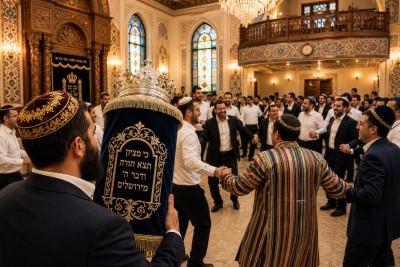
“The true groom is not the one who danced at the wedding — it is the one who brought the bride home.”
The name of the parashah, Naso, can mean to count, but its root also alludes to nisuin — marriage. It is a profound linguistic connection, especially considering that Parashat Naso is always read on the Shabbat immediately following Shavuot.
In many ways, this specific Shabbat resembles the Shabbat after a wedding—the great wedding between am Yisrael and the Torah. Among Ashkenazim, such a Shabbat is celebrated as Shabbat Sheva Berachot, while among Sephardim it is traditionally known as Shabbat Chatan.
One year on this exact Shabbat, people approached Rav Aharon Yehuda Leib Shteinman, ztk”l, and wished him a heartfelt, joyous “Mazal tov!”
The visual giant of Torah responded with a penetrating insight: “‘Mazal tov’ is indeed a beautiful thing to say — but only if the groom has not run away from the bride. It is only a true celebration if the holy Torah has actually remained together with us.”
There are many people who experience an uplifting, deeply inspiring Shavuot night. They stay up learning, immerse themselves in the holiness of the day, and feel elevated. Yet the moment the holiday ends, that inspiration begins to evaporate. The “groom,” so to speak, walks away from the “bride.” For the mazal tov to be a genuine milestone, the relationship must survive the end of the celebration.
This is precisely why the Shabbat after Matan Torah is so significant. It serves as a spiritual mirror, revealing whether the holiday inspiration was merely fleeting emotional excitement or whether a genuine, enduring bond with Torah was formed.
Perhaps this also explains why Parashat Naso is the single longest parashah in the entire Torah, and why the longest section in the Zohar is found within it.
Immediately after receiving the Torah, we are handed a test: Do we still have patience for Torah once the initial excitement has passed? Do we still have the desire to listen carefully to a lengthy Torah reading? Do we still commit ourselves to Shnayim mikra ve’Echad targum even when the portion is exceptionally long? That endurance is the true acceptance of Torah.
A beautiful mashal (parable) captures this idea perfectly. At a wedding, everyone arrives dressed elegantly. Everyone dances, smiles, and celebrates. Looking around the room, it may seem as though every individual is equally connected to the joyous occasion. But when the night concludes and the lights dim, how do you identify the actual groom?
The answer is simple: only one person leaves together with the bride. Everyone else returns home alone. The others came to celebrate, but they were ultimately just guests. The groom is the one who continues building a life together with the bride long after the music stops.
So too with Shavuot. Everyone rejoices. Everyone feels inspired. The upper worlds rejoice, and the lower worlds exult. But who is the true chatan of the Torah?
It is the person who takes the Torah home. It is the individual who brings Torah into daily life after the holiday has passed, who continues learning even after the initial inspiration fades, and who remains firmly connected long after the dancing ends. That is the person who truly becomes a chatan to the Torah.
Based on teachings from Rav Aharon Yehuda Leib Shteinman, zt”l, and Naeh Doresh.
Rabbi Leeor Dahan, a graduate of Yeshiva Chofetz Chaim/RSA, is a noted scholar and teacher, well-versed in halachah. He currently leads Kehilat Avodat Hashem in Hillcrest, Queens, inspiring his congregation to delve into Torah study and embrace its eternal teachings.
Are We Guests Or The Groom?
Typography
- Smaller Small Medium Big Bigger
- Default Helvetica Segoe Georgia Times
- Reading Mode