


“Surely this great nation is a wise and understanding people” (Devarim 4:6).
A young Torah scholar once came to the Beit HaLevi seeking semicha. The custom was to examine a candidate over the course of several days, and the young man proved to be exceptionally well versed in Torah. The Beit HaLevi concluded that the scholar was certainly worthy of receiving ordination.
As the Beit HaLevi was preparing the document, a woman entered with a practical halachic question. This presented another opportunity to observe how the candidate would apply his knowledge to an actual case.
The woman explained that she had slaughtered five geese, one of which was found to be a treifah. She placed the liver, gizzard, and one leg from the treifah goose into a paper bag, intending to give them to her non-Jewish maid.
Before salting the legs of the four kosher geese, however, she discovered nine legs among them. Four kosher geese should have produced only eight legs. It was therefore clear that the leg from the treifah had fallen among the kosher ones before they had been salted.
The woman placed the legs before the Beit HaLevi and asked whether the nonkosher leg could be identified and what the halachic status of the remaining legs would be.
The Beit HaLevi turned to the young scholar and asked, “What would you answer to such a question?”
The young man replied, “There is no solution. According to the ruling of the Shulchan Aruch, this is a mixture, and goose legs are considered a davar chashuv—an important item that cannot be nullified. Therefore, all nine legs are forbidden, because safek d’Oraita l’chumra: in a matter of Torah law, a doubt is treated stringently.” (See Yoreh Deah 101:3, in the Rema.)
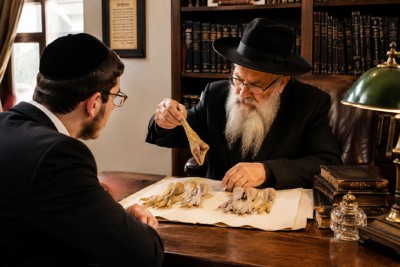
The Beit HaLevi picked up one of the legs and examined it. The young scholar watched in astonishment, wondering whether the Beit HaLevi was somehow identifying the leg through ruach haKodesh, Divine intervention.
The Beit HaLevi continued examining the legs and separated them into two piles: one containing four legs and the other containing five. The Beit HaLevi then told the woman, “These four are kosher, while the other five are forbidden.”
Turning to the young scholar, the Beit HaLevi explained, “There is a visible difference between the right leg and the left leg of a goose, which can be recognized by the position of its toes. There must therefore be five right legs and four left legs, or five left legs and four right legs.”
Whichever side—right or left—was represented by only four legs was certainly kosher. The group of five contained the additional leg from the treifah, leaving all five forbidden because of the doubt.
The Beit HaLevi then added, “Although you know the entire Shulchan Aruch, you must also possess practical wisdom. A person must look carefully and thoughtfully even at the simplest details. The four matching legs are clearly kosher; only the remaining five are forbidden because of the doubt.”
This is part of the meaning of shimush talmidei chachamim—spending time in the company of Torah scholars and learning by observing how they think and act. Not every form of wisdom is written explicitly in the Shulchan Aruch. Some lessons can be acquired only by watching great Torah scholars apply their knowledge to the realities of life.
Based on a teaching presented by Rav Menashe Yisrael Reisman, shlit”a, in Naeh Doresh.
Rabbi Leeor Dahan, a graduate of Yeshiva Chofetz Chaim/RSA, is a noted scholar and teacher, well-versed in halachah. He currently leads Kehilat Avodat Hashem in Hillcrest, Queens, inspiring his congregation to delve into Torah study and embrace its eternal teachings.
Parshat Va’etchanan: A Window Into The Wisdom Of Torah Scholars
Typography
- Smaller Small Medium Big Bigger
- Default Helvetica Segoe Georgia Times
- Reading Mode