


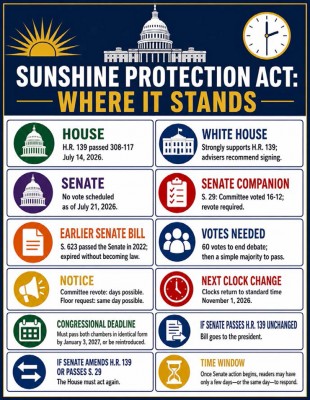

The House has voted to end clock changes by keeping Daylight Saving Time year-round. No Senate vote has been scheduled, and none is guaranteed.
On Tuesday, July 14, 2026, the House of Representatives passed the Sunshine Protection Act (H.R. 139) by a bipartisan vote of 308-117. Backed strongly by the White House—with advisers recommending that President Donald Trump sign it—the bill now moves to the Senate, where its future is far less certain.
Most of the country springs forward in March and falls back in November. H.R. 139 would lock in Daylight Saving Time year-round while preserving exemptions for states and territories already permitted to remain on standard time, such as Hawaii and most of Arizona.
The House approved the measure largely because voters are weary of resetting clocks, losing sleep, and navigating seasonal disruptions. Proponents argue that later winter sunsets provide more family outdoor time, boost consumer activity, and shift daylight to hours when most people are awake. The House Energy and Commerce Committee previously advanced the bill 48-1, and White House support solidified Republican backing.
Two Distinct Questions
Congress actually faces two separate questions: Should we stop changing the clocks, and if so, should permanent Daylight Saving Time or permanent standard time replace the current system?
The House voted only on permanent Daylight Saving Time under a closed rule that barred floor amendments. Representative Mary Gay Scanlon sought a vote on an alternative offering permanent standard time and state flexibility, but the House Rules Committee rejected it 6-4, leaving members without a direct choice between the two models.
The Orthodox Community's Concerns
That distinction is crucial for the Orthodox Jewish community. Essential daily markers—the earliest times for tallis and tefillin, preferred times for Shemoneh Esrei, and other morning zmanim governing Shacharis—depend entirely on the sun's position, not human clocks.
Permanent Daylight Saving Time does not change sunrise; it pushes every winter zman one hour later on the civil clock. In Queens, a late-December sunrise currently just after 7:15 a.m. would occur shortly after 8:15 a.m. A vasikin minyan would reach Shemoneh Esrei right around that time, squeezing the window between early morning zmanim and the start of work or school.
Parents leaving home by 7:30 a.m. or employees starting work at 8:30 a.m. would find regular weekday minyanim increasingly difficult to fit into their schedules. Shuls would likely need to shift minyan times later, workers would face more accommodation requests, and yeshivos would confront scheduling friction across davening, transportation, and classes.
These impacts will vary by region. Northern communities and cities near the western edges of time zones—where winter sunrises already occur later—would see morning sunrises pushed past 9 a.m. Consequently, senators from those regions may prove especially sensitive to concerns involving school transit, early shifts, construction schedules, and religious observance, seamlessly connecting these local communal realities to the broader national legislative debate.
Organizational Stance and History
Agudath Israel of America and the Orthodox Union support ending twice-yearly clock changes, but both strongly oppose doing so via permanent Daylight Saving Time. They are urging Congress to pursue permanent standard time or maintain the current system to prevent winter mornings where the sun rises after 8 or 9 a.m.
Agudath Israel’s opposition has deep roots. During a previous legislative push for permanent Daylight Saving Time in 1971, Rav Moshe Feinstein, zt”l, wrote a teshuvah to then-Agudath Israel President Rabbi Moshe Sherer, z”l. Addressing the collision between proper davening and timely arrival at work, Rav Moshe called the proposal a gezeirah mamash al hatefila lirai Hashem Yisborach—translated by Agudath Israel as "a real decree on prayer for those who fear G-d."
The Senate Landscape
In the Senate, the policy divide is proving difficult to ignore. Senate Majority Leader John Thune has questioned whether supporters have the 60 votes required to break a filibuster and advance the bill. Representing South Dakota—a northern state facing exceptionally late winter sunrises—Thune previously voted against the proposal in committee.
Senator Tom Cotton of Arkansas is another vocal opponent. On October 28, 2025, Cotton blocked Senator Rick Scott’s attempt to pass the Senate companion bill by unanimous consent, warning that permanent Daylight Saving Time would plunge schoolchildren into morning darkness. While Cotton’s objection halted that fast-track attempt, it does not prevent leaders from pursuing regular floor action.
The Senate Commerce Committee initially advanced its companion bill, S. 29, by a 16-12 vote on April 30, 2025, though committee leadership later noted a revote is required to comply with in-person attendance rules.
Legislative Background
Congress has weighed multiple iterations of the Sunshine Protection Act over recent years. An earlier bill, S. 623, unanimously passed the Senate on March 15, 2022, aiming to make Daylight Saving Time permanent by November 2023. However, the House never voted on it, and the bill expired with the 117th Congress.
Introduced in January 2025, S. 29 serves as the current Senate companion to H.R. 139, sharing virtually identical provisions. Unlike the expired 2022 measure, neither S. 29 nor H.R. 139 includes a delayed effective date or a fixed implementation timeline, leaving the transition mechanism entirely dependent on when enactment occurs. Furthermore, qualifying exemptions for standard-time states are anchored to current pre-enactment status rather than past dates.
Path Forward in the Senate
H.R. 139 represents the most direct path to the White House because it has already cleared the House. If the Senate passes it unchanged, it goes straight to the president. If the Senate amends it or passes S. 29 instead, the House must vote again to reconcile the text.
Senate procedure offers two distinct avenues for action:
- Unanimous Consent: Supporters could attempt another same-day fast-track request, mirroring the 2022 Senate passage. However, because Senator Cotton or any other member can instantly block it with a single objection, this route remains unlikely unless opposition softens.
- Regular Floor Process: The Commerce Committee could schedule its required revote, or leadership could bypass committee and bring the bill directly to the floor. Under regular order, supporters would need 60 votes to overcome a filibuster.
As of Tuesday, July 21, 2026, no committee revote or floor vote has been scheduled, and leadership is under no deadline to act. Under standard rules, a cloture vote typically occurs roughly two days after filing, leaving constituents with very narrow notice before a decisive vote.
The ultimate legislative clock is the end of the 119th Congress on January 3, 2027. Any version that fails to clear both chambers in identical form by that date must be reintroduced from scratch. Under current law, regular clock changes are set to resume on Sunday, November 1, 2026, making enactment timing a critical practical factor.
Health and Historical Context
Health professionals draw the same critical distinction between ending clock changes and choosing permanent Daylight Saving Time. Sleep specialists agree that shifting clocks disrupts circadian rhythms, but emphasize that permanent Daylight Saving Time is not the healthiest remedy. The American Academy of Sleep Medicine advocates for permanent standard time, noting it aligns far more closely with human biology and natural light cycles.
History also offers a clear warning. When Congress enacted year-round Daylight Saving Time during the 1974 energy crisis, the resulting dark winter mornings quickly sparked widespread public backlash. Lawmakers cut the experiment short later that year to restore winter standard time—proving that enthusiasm for late evening light evaporates rapidly once families experience post-8 a.m. winter sunrises.
The Orthodox community's position is clear: it does not seek to preserve an inconvenient clock ritual out of habit. Rather, it urges lawmakers not to solve one logistical irritation by creating a far more severe disruption to winter mornings. No act of Congress can manufacture an extra hour of sunlight; it can only shift what the clock reads when dawn arrives. For Torah-observant Jews, civil time is set by law, but zmanim are set by the sun.
By Shabsie Saphirstein
The Clock Conundrum Returns: Permanent Daylight Saving Time Moves To The Senate
Typography
- Smaller Small Medium Big Bigger
- Default Helvetica Segoe Georgia Times
- Reading Mode