


From Samarkand and Bukhara to New York: The Story of Faith, Family, and a Community Rebuilt Across Continents
The Bukharian Jewish community of Queens was built one family, one shul, one business, and one institution at a time. Its foundations were laid by immigrants who carried centuries of Jewish tradition from Central Asia to New York and transformed unfamiliar streets in Forest Hills and Rego Park into one of the most important centers of Bukharian Jewish life in the world.
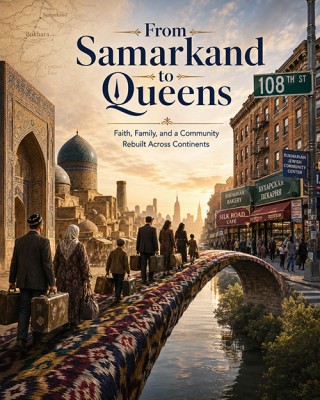
Long before kosher markets, synagogues, restaurants, schools, and community institutions became fixtures of central Queens, Bukharian Jews were preserving a distinct way of life thousands of miles away in cities including Samarkand and Bukhara and throughout what are now Uzbekistan and Tajikistan.
Under Soviet rule, religious life was severely restricted. Formal Jewish education became difficult or impossible for many families, public religious expression was constrained, and generations learned to preserve identity within the home. Parents and grandparents passed down prayers, customs, melodies, recipes, and Bukhori, the Judeo-Persian language closely related to Tajik that had long served as a defining element of Bukharian culture.
What survived did so because families made sure it survived.
Bukharian immigration to New York began in earnest during the 1970s and grew dramatically after the collapse of the Soviet Union in 1991. Families left behind familiar neighborhoods, relatives, professions, and a way of life rooted in Central Asia for generations. Many arrived in America with limited English and faced the immediate demands of finding work, securing housing, navigating an unfamiliar system, and raising children in a country that offered extraordinary freedom but also an entirely different culture.
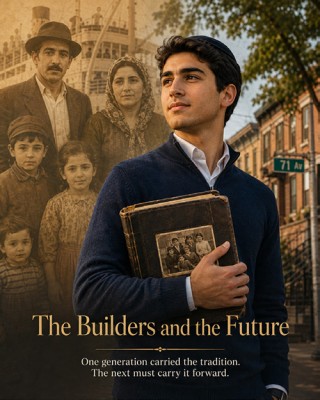
Among those early builders was Gavriel Davidov, who immigrated from Tajikistan to New York with his wife, Zoya, and their four daughters in 1976. Over nearly five decades in Forest Hills, Davidov became a trusted communal figure and helped establish numerous Bukharian synagogues, yeshivot, and community institutions. His story reflects a broader generation of immigrants who understood that rebuilding Jewish life required more than earning a living. It required creating the institutions their children and grandchildren would inherit.
Building Bukharian Queens
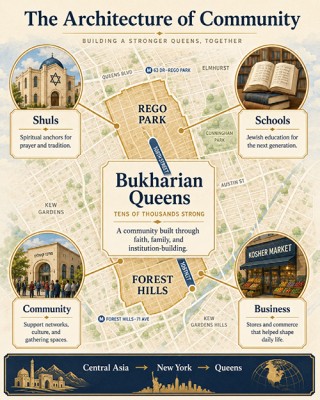
Forest Hills and Rego Park became the heart of Bukharian Jewish life in New York. Families settled near one another, often helping relatives and friends find apartments, jobs, schools, and places to pray. In time, 108th Street emerged as a commercial and communal artery so closely associated with the community that it became widely known as “Bukharian Broadway.”
The immigrants who established themselves in Queens understood that communal continuity could not be taken for granted. They opened shuls where families could daven according to ancestral traditions. They helped establish schools and yeshivot so children could receive the Jewish education that had been denied to so many of their parents and grandparents. They built community organizations to assist new arrivals and created businesses that provided both livelihoods and familiar gathering places.
Kosher markets, bakeries, restaurants, jewelers, professionals, and family-run stores became part of the neighborhood landscape. These businesses did more than serve customers. They created employment, helped new immigrants find their footing, and gave Bukharian Jews places where language, food, and community could remain part of everyday life.
Every institution represented sacrifice. The builders were creating permanence.
Preserving Identity In A New Country
Perhaps the community’s most striking achievement has been its ability to preserve a distinct identity while becoming fully rooted in American life.
The children and grandchildren of the first major waves of immigration grew up moving naturally between worlds. They attended American schools and universities, entered medicine, law, business, education, public service, and other professions, and increasingly assumed leadership roles throughout New York. At the same time, many remained closely connected to the customs that shaped their families.
That continuity can still be seen around the Shabbat and Yom Tov table, in the melodies heard in Bukharian shuls, and in dishes such as osh palav and bakhsh that remain inseparable from family gatherings. Foods once prepared almost entirely inside private homes became part of a thriving Bukharian restaurant culture, allowing neighbors from across Queens to encounter traditions that had traveled thousands of miles.
The community itself has also expanded geographically. While Forest Hills and Rego Park remain central to the Bukharian story, younger families have increasingly established themselves in Kew Gardens Hills and other nearby neighborhoods, carrying communal life into a new stage without abandoning the institutions built by the generation before them.
The result is a community shaped by two histories at once: the inherited story of Central Asia and the American story its families built in Queens.
The Responsibility Of The Next Generation
Every generation faces a different challenge.
Earlier generations struggled to preserve Jewish identity under a system that restricted religious education and expression. The immigrants who came to America faced the challenge of rebuilding that life almost from the ground up while learning how to survive in a new country.
The next generation faces a quieter test: whether traditions protected through persecution and rebuilt through sacrifice will remain strong in an era when assimilation can happen without coercion.
Preserving Bukharian Jewish life requires more than remembering where grandparents lived or serving traditional foods on special occasions. It means carrying forward the values that allowed the community to endure: respect for Torah and tradition, devotion to family, responsibility for neighbors, support for communal institutions, and a sense of obligation to the broader Jewish world.
Heritage survives when it becomes part of daily life.
Honoring The Builders
Many of the men and women who built Bukharian Queens never expected public recognition. They were occupied with practical concerns: supporting families, helping newly arrived relatives, opening businesses, creating minyanim, raising money for schools and shuls, and making certain that the next family to arrive would have an easier beginning.
Their success is visible throughout Queens today.
It is visible in packed shuls, in children receiving a Jewish education, in businesses that have served generations of families, and in community organizations that continue to respond whenever someone needs help. It is visible in families whose grandparents arrived speaking little English and whose grandchildren now help lead the borough they once struggled to navigate.
The story of Bukharian Queens is not simply a story of immigration. It is the story of a community that carried an ancient inheritance across continents and then built the physical and spiritual infrastructure needed to keep it alive.
The builders completed one chapter. The responsibility for the next belongs to the generations who inherited what they created.
By Shabsie Saphirstein
From Central Asia To Queens — A Community Timeline
Centuries Ago: Bukharian Jewish communities develop across Central Asia, particularly in cities including Bukhara and Samarkand, preserving distinctive religious, linguistic, musical, and culinary traditions.
20th Century: Soviet rule places severe restrictions on organized religious life. Families preserve Jewish identity largely through the home, private observance, and traditions passed from one generation to the next.
1970s–1980s: Bukharian Jewish immigration to New York begins to grow, with early families establishing themselves primarily in Forest Hills and Rego Park.
1990s: The collapse of the Soviet Union leads to a much larger migration to the United States and Israel. Queens becomes home to tens of thousands of Bukharian Jews.
Following Decades: Synagogues, yeshivot, community organizations, kosher businesses, restaurants, and cultural institutions expand throughout central Queens. 108th Street becomes widely associated with Bukharian Jewish commercial and communal life.
Today: Bukharian Jewish life continues to flourish across Queens, with younger families increasingly establishing themselves beyond Forest Hills and Rego Park while remaining connected to the institutions built by earlier generations.
The Generation That Built Bukharian Queens
Typography
- Smaller Small Medium Big Bigger
- Default Helvetica Segoe Georgia Times
- Reading Mode