


On a typical July afternoon, the rhythm of Jewish Queens changes. From Forest Hills and Kew Gardens to Kew Gardens Hills, Fresh Meadows, and Jamaica Estates, families head north for camp visiting days, bungalow colonies, summer rentals, or weekends in the Catskills. School traffic disappears, driveways sit empty, and neighborhoods accustomed to the pace of the school year grow quiet.
The volunteer organizations serving those neighborhoods, however, cannot close for the summer.
Medical emergencies still require a response. Motorists still get stranded with dead batteries or flat tires. Hospital patients, homebound seniors, and families coping with illness still need meals, transportation, visits, and support.
The summer challenge is maintaining those services while part of the community—and some of its volunteers—temporarily relocates.
Hatzolah provides the clearest example.
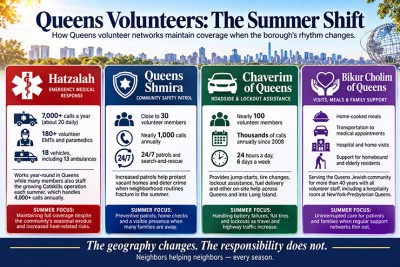
Queens Hatzolah and Great Neck responds to more than 7,000 calls each year, roughly 20 a day, with more than 180 volunteer EMTs and paramedics and a fleet of 18 vehicles, including 13 ambulances.
At the same time, another large Hatzalah operation comes alive about two hours north. Catskills Hatzalah began in the 1980s as a small group serving several hundred families vacationing near Fallsburg. It now covers hundreds of bungalow colonies and summer camps and reports more than 450 EMTs and paramedics handling more than 4,000 emergency calls annually.
In a published interview about its summer operations, Catskills Hatzalah coordinators explained that many of its upstate EMTs are New York City Hatzalah members who bring their radios with them. They estimated that approximately 125 to 150 members are in the Catskills during the week, rising to roughly 350 on weekends.
Part of the emergency network does not disappear during the summer. It moves with the population.
Catskills Hatzalah uses dispatchers familiar with rural roads, camps, and bungalow colonies, while Central Hatzalah maintains round-the-clock dispatching in the city. A responder active in New York City for most of the year may answer calls in Sullivan County in July, while volunteers remaining in Queens continue covering their neighborhoods.
Summer weather adds another concern. In mid-July, Queens endured a stretch of dangerous heat, with heat-index values reaching as high as 104 degrees, followed by additional heat advisories later in the month. Conditions like these add the risk of heat illness and dehydration to the medical emergencies Queens Hatzolah already handles throughout the year, from falls and chest pain to pediatric emergencies and injuries. Even as neighborhood streets grow quieter, the need for emergency response remains.
Chaverim of Queens faces a different summer reality.
Founded in January 2008 with ten volunteers handling three or four calls a day, Chaverim has grown to nearly 100 volunteers responding to thousands of calls throughout Queens and into parts of Long Island.
Its work is practical: flat tires, dead batteries, vehicle and home lockouts, motorists who run out of gas, and children accidentally locked inside cars. The organization operates 24 hours a day, six days a week, with volunteers carrying equipment including booster packs, air compressors, hydraulic jacks, tire-repair kits, and lockout tools.
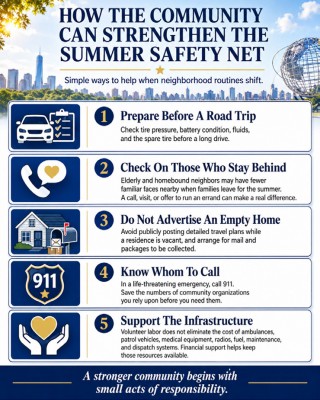
Summer travel can make those problems considerably more serious. A dead battery in a Kew Gardens Hills driveway before a trip to the Catskills is frustrating. A disabled vehicle on a highway shoulder with children inside during 90-degree heat can quickly become dangerous.
For the Chaverim member arriving with the right equipment, the repair may take only a few minutes. For the stranded family, those few minutes can change the entire situation.
Community safety organizations also adjust to changing neighborhood patterns.
Queens Borough Safety Patrol-Shmira, founded in 2016, is an all-volunteer organization providing patrols, search-and-rescue assistance, and emergency services around the clock. Published figures place its membership at close to 30 volunteers handling nearly 1,000 calls annually.
Patrol is an important part of that work.
This spring in Richmond Hill, residents raised safety and quality-of-life concerns around Babbage and Bessemer Streets. State Senator Joseph Addabbo worked with the NYPD’s 102nd Precinct to secure two security cameras for the area. When announcing their installation in May, Addabbo specifically thanked Queens Shmira for increasing patrols there.
That example shows the less visible side of volunteer safety work. Residents identify a problem, volunteers increase their presence, law enforcement becomes involved, and preventive measures are put in place.
Those efforts take on added importance when schools are closed, children remain outside later, and many families are away. Fewer residents may be around to notice unusual activity on normally busy blocks.
Preventive patrols rarely produce dramatic endings. Their purpose is to reduce the likelihood of one.
The quieter side of the volunteer network is just as important.
Bikur Cholim of Queens has served the greater Queens Jewish community for more than 40 years through an all-volunteer operation. Its services include short-term home-cooked meals, transportation to medical appointments, a medical-equipment gemach, hospital visits, visits to homebound residents, and a Grab 'n Go freezer initiative.
At NewYork-Presbyterian Queens, Bikur Cholim maintains a hospitality room stocked with refreshments for patients’ relatives. Weekly Shabbos meals are provided through Satmar Bikur Cholim, and accommodations are available for relatives who need to remain near hospitalized family members over Shabbos or Yom Tov.
Those needs do not disappear in August. Patients remain hospitalized. Families still need meals. Medical appointments continue. Homebound and elderly residents may have fewer familiar neighbors nearby while others are away.
There are no sirens attached to that work, but it fills gaps that become especially noticeable when the usual neighborhood support system is thinner.
Keeping these organizations operating also requires significant funding. The volunteers may be unpaid, but ambulances, medical equipment, radios, patrol vehicles, insurance, fuel, dispatch systems, maintenance, and training all cost money.
In April 2025, Assemblymember Nily Rozic announced $350,000 in state funding for a new Queens Hatzolah ambulance, replacing an older vehicle and adding emergency-response capacity.
New York City Council budget records for Fiscal Year 2026 allocated $40,000 to Queens Borough Safety Patrol for community safety patrols in Council District 24 and another $25,000 for public-safety and security work covering Council District 29.
Chaverim relies on private donations to help provide volunteers with the equipment they need to answer calls.
Behind those numbers are ordinary people with responsibilities of their own.
They are business owners, teachers, professionals, parents, retirees, and neighbors. They have jobs, families, vacations, appointments, and summer plans like everyone else.
A Queens Hatzolah member who responds locally for most of the year may answer calls in the Catskills during July. A Shmira volunteer may patrol after a full day of work. A Chaverim member may leave home with a booster pack because someone’s car will not start. A Bikur Cholim volunteer may deliver dinner to another family before sitting down with his or her own.
For the Bukharian and broader Orthodox Jewish communities of Queens, that sense of responsibility is familiar. Chesed is not reserved for moments when helping is convenient. It means recognizing when another person needs assistance and being willing to respond.
Summer rearranges the map. Families leave, some volunteers go with them, and others remain. The Catskills network expands while Queens continues to need coverage. Hospitals remain open, cars break down, safety concerns arise, and medical emergencies happen.
The rhythm changes, but the responsibility remains.
By Shabsie Saphirstein
The Summer Shift: How Queens Volunteer Networks Maintain Coverage When The Rhythm Changes
Typography
- Smaller Small Medium Big Bigger
- Default Helvetica Segoe Georgia Times
- Reading Mode