



Charlene Aminoff Shares Lessons On Gratitude, Relationships, And Emunah
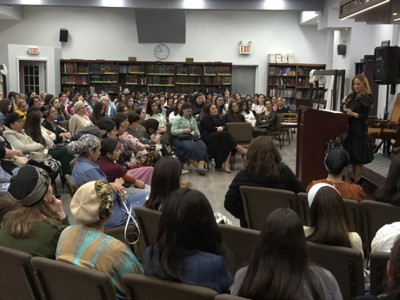
Long before the program began, women streamed into Ohel Simcha in Kew Gardens Hills. The entire beit hamedrash had been converted into an ezrat nashim to accommodate the overflowing crowd. Women of all ages and backgrounds gathered for an evening centered on strengthening relationships, personal growth, and emunah. The annual program was held in memory of Dora bat Zipla a"h, and hosted by Chazaq in partnership with Amudim.
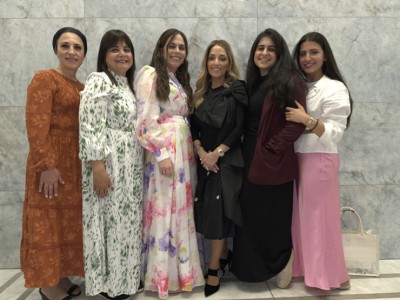
In her opening remarks marking her mother's sixth yahrzeit, the daughter spoke candidly about the unique void left by a mother's passing. She shared that as she has matured, she looks in the mirror and sees her mother’s reflection in her own appearance and hands. Yet, she also shared the brachot that followed her loss, including her own marriage, the birth of her three children, and several recent family milestones. She recalled a beautiful, comforting dream where her mother appeared and spoke five words in Bukharian: "Your troubles are very short. Soon you're going to have nachat."
A fellow co-organizer, then introduced the evening's themes and noted that since 2017, Chazaq has successfully transferred more than 3,000 Jewish children from public schools into yeshivot. The organizer’s close friend then connected the recent Yom Tov of Shavuot to the evening's message. She expressed that the Torah describes the two Luchos as Shnei Luchot HaBris, meaning they were exactly equal in size, weight, and shape. Chazal explain this physical equality teaches that a person's relationship with Hashem and their relationship with a fellow Jew carry identical spiritual weight. Expanding on this idea, Leora shared a lesson from Rabbi Zecharia Wallerstein zt"l regarding the biblical diagnosis of tzaras. A Kohen must look twice at a lesion before declaring a person tameh. Rabbi Wallerstein explained this as a vital lesson in community unity: before writing off another Jew, one must look twice, use an ayin tovah (a good eye), and search for the positive strengths inherent in every person.
Mrs. Mirel Bennett then joined Leora on stage. A Kew Gardens Hills native, Bennett—the daughter of Dr. Yisroel Mordechai and Chavie Dick, and the granddaughter of Rav Noach Isaac and Rebbetzin Chaya Oelbaum of Khal Nachlat Yitzchok—now resides in Lakewood with her husband, Simcha, and their family. Through her stirring rendition of “I Will Keep Holding On,” she offered a musical message of navigating communal and personal pain through unwavering faith.
Charlene opened her remarks by describing a social experiment involving a large whiteboard with a tiny black dot in the corner. Participants fixated entirely on the black dot, completely overlooking the vast expanse of white surrounding it. Charlene used the visual to illustrate how easily we become consumed by isolated flaws, marital frustrations, and parenting disappointments, while ignoring the overwhelming blessings in our lives. “We cannot eliminate the darkness of this world, but we can overpower the dark by actively amplifying the light through gratitude.”
Much of Charlene's presentation focused on marriage. She explained that human connections truly flourish when a spouse stops tallying what is missing and focuses instead on what they can give. Appreciation, she emphasized, transforms a home when it becomes a daily habit rather than an occasional gesture. She encouraged attendees to let go of old resentments, noting that forgiveness often heals the person carrying the hurt just as much as the one who caused it. Grounding her advice in her own journey, Charlene spoke openly about enduring eleven miscarriages before being blessed with five children. She shared how that painful period fundamentally shaped her outlook on faith, gratitude, and perseverance.
Turning to parenting, she shared a psychology experiment involving two identical plants: one grown with words of love and praise, the other subjected to constant criticism. Within weeks, the praised plant blossomed while the criticized plant withered. The lesson was profound: children thrive when built up through encouragement, rather than being defined by rules, restrictions, or perceived shortcomings. Charlene warned against the trap of immediate interrogation—barraging children about homework or missing davening the moment they cross the threshold. She urged the audience to “loosen the grip” and let them breathe. Ultimately, Charlene said, the health of a person's relationship with Hashem is reflected in how they treat a spouse, child, friend, or fellow Jew.
Charlene also shared a story from the Living Emunah series about a childless couple and the Baal Shem Tov, a poignant reminder to maintain faith and gratitude even when answers do not arrive on our own timetable. Charlene concluded with a powerful story about a woman sheltering in the Mir Yeshiva during the Six-Day War, who publicly forgave the husband who had left her an agunah for two decades. She used the account to illustrate the transformative power of forgiveness, tying together the evening's central themes of gratitude, appreciation, giving, and emunah.
Rather than rushing out at the end of the program, many women lingered in the shul to speak with Charlene personally, sharing their own struggles and the realities of their daily lives. The night concluded with joyous music and dancing as women of all ages joined hands serving as a living tribute to Dora bat Zipla a"h. The shiur brought the community together around gratitude, forgiveness, and faith, strengthening the foundational links of Jewish life: between parents and children, husbands and wives, friends and neighbors, and ultimately, between every Jew and our Creator.
By Shabsie Saphirstein
Beyond The Black Dot
Typography
- Smaller Small Medium Big Bigger
- Default Helvetica Segoe Georgia Times
- Reading Mode