


One Year After Rachel Aliza Nisanov’s Passing, Her Family Remembered The 13-Year-Old Daughter, Sister And Friend Whose Small Acts Of Love Have Become Impossible To Forget
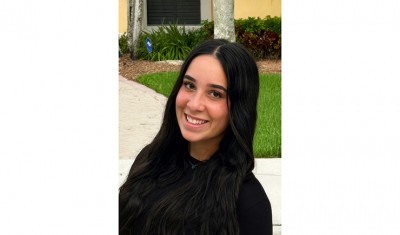
There are photographs that become harder to look at as time passes, not because the face in them has faded, but because the person looks so completely alive. Rachel Aliza Nisanov is smiling in the portrait chosen for her one-year memorial, her long dark hair falling over her shoulders as she looks straight into the camera with the easy expression of a 13-year-old girl who had no way of knowing that those who loved her would someday study every familiar detail—her smile, her eyes, the way she stood—searching for anything that might bring Racheli, as nearly everyone called her, close again.
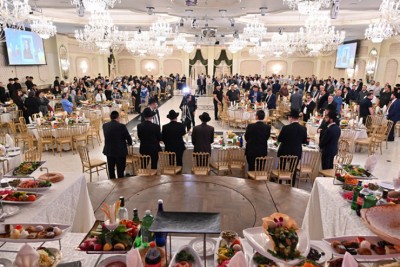
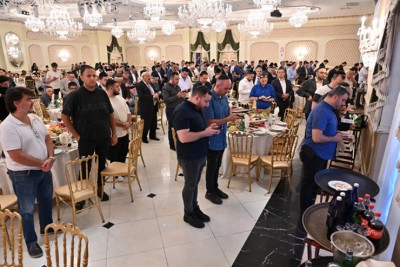
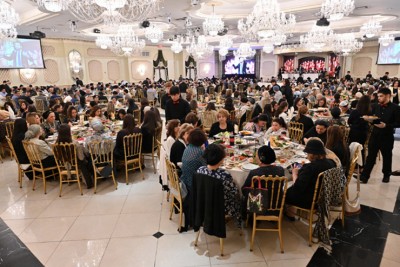
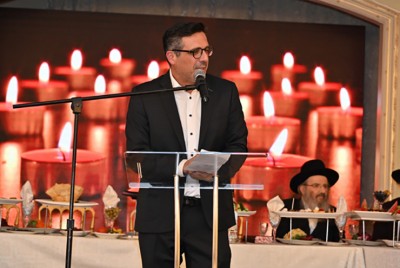
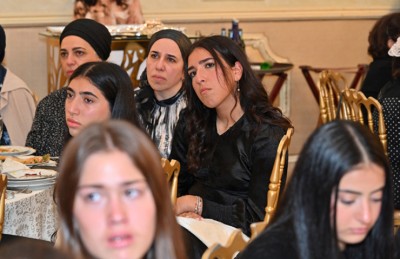
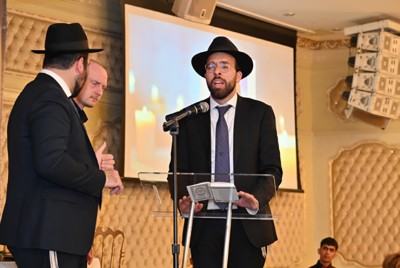
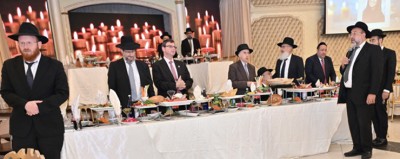
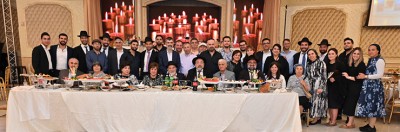
On Monday evening, August 3, family members, friends, Rabbanim and members of the community gathered in Woodside to mark one year since Rachel Aliza’s passing. The ballroom was filled from front to back, with Racheli’s image displayed prominently as those who knew and loved her returned to a setting associated with the family’s earliest days of mourning. This time, they had not come to sit shivah. They came to remember, to learn, to complete a siyum and to carry something from her short life forward.
The day itself had begun under pounding rain. Yonah recalled waking early to water striking so hard against the house that he feared it might be coming inside, and he was soaked when he went out that morning. For hours, it seemed as though the weather would remain dark and miserable, but later the sun came out. Yonah used that change to describe something the family still longs to reach: the darkness has not disappeared and the unanswered questions remain, but a person can continue doing good even before the clouds fully clear.
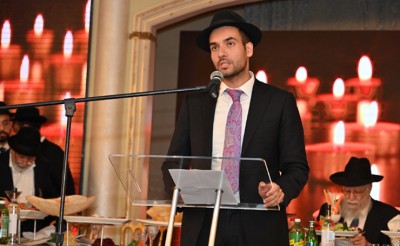
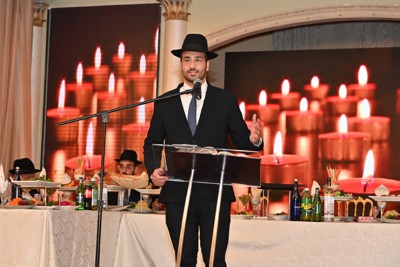
As the speeches began, the memorial gradually became something more intimate than a formal commemoration. Through the voices of siblings, parents and a grandfather who at times struggled to continue, Rachel Aliza stopped being only the subject of a tragedy and became again the girl they had known—a daughter, sister, aunt, granddaughter and friend whose habits and small acts of kindness remained painfully vivid.
The Girl Who Left A Clean House
Yonah remembered something his mother had reminded him of earlier that day: Racheli liked buying gifts for her friends. She did not stop to calculate whether they had done something for her, whether the favor would ever be returned, or whether anyone else would even know. She simply gave because making somebody else happy mattered to her.
That same quality showed itself at home. Yonah and his wife would sometimes ask Racheli to babysit so they could have a little time to themselves. She would come over and watch the children, but that was rarely all she did. By the time her brother returned, the children were safe, the toys had often been put away, the dishes washed and the house straightened.
There was no announcement that she had done more than expected and no request for additional pay. In fact, Yonah recalled, she frequently did not ask him for money at all. “She did and she did and she did,” he said, a simple repetition that told the room more about his little sister than a long description could. One could picture her moving quietly through her brother’s home, doing the things nobody had asked her to do simply because they needed doing.
Those details belong not to how Racheli died, but to how she lived. They reveal a 13-year-old girl who noticed what other people needed and responded without keeping score, the sort of quiet kindness that can seem ordinary until the person who performed it is no longer there.
The year since her passing has included births, semachot and new grandchildren. Life has continued, but Racheli’s absence has followed the family into some of its happiest moments, where joy and loss now exist beside one another in ways they never did before.
Her brother Nissan described that collision after the birth of his first son. After three daughters and a long wait, he held his newborn boy in his arms and began to cry. His mother-in-law assumed they were tears of happiness, but his wife immediately understood that something deeper had broken through.
His mother was on the telephone when Nissan tried to explain it. “Mommy,” he said, “I’m holding something that you lost.” Then he put into words what grief had done to some of the family’s happiest moments: “In the happiest time of my life, I feel your pain the most.” Holding his own child made him understand, with a force he had not expected, what his parents had lost.
That realization returns during ordinary family moments as well. Nissan spoke about sitting with his children each Shabbat. One daughter reminds him strikingly of Racheli in appearance, while another bears a name whose sound brings Rachel Aliza to mind. He looks at his children growing and suddenly feels the future his parents were denied.
The Phone Call That Broke Time
There are memories from the night of the tragedy that have not loosened their hold on the family. At first, Nissan understood that they might be dealing with a broken leg, but then the telephone calls became more frightening and there was uncertainty over whether there was a pulse.
He remembered the physical sensation of terror as the situation changed, describing chills beginning at the base of his spine and moving upward toward his head. He and his brother Gedalya Meir rushed to the Kotel, where Nissan found himself asking Hashem for something he had never imagined needing to ask: that his sisters remain alive.
Then Yonah called and said, “I need to tell you something.” Nissan heard enough in his brother’s voice to know what might be coming. “Who? Don’t tell me. Don’t tell me who,” he remembered pleading, because at that moment he did not know whether he was about to hear one name or two. Aviva survived. Rachel Aliza did not. In a matter of moments, the family was left confronting the unbearable loss of one daughter while holding onto profound gratitude that another had survived.
The disbelief that followed was immediate. Relatives, friends and members of the community reacted as though there had to be some mistake. It could not be this family, Rabbi and Rebbetzin Nisanov’s daughter, or the little sister, granddaughter, cousin and friend they knew. People seemed to be waiting for someone to tell them they had misunderstood, but that correction never came.
When A Community Tried To Carry The Weight
During the shiv’ah, Eli noticed something that remained with him. People arrived expecting to comfort his parents and sometimes found Rabbi and Rebbetzin Nisanov trying to strengthen them instead. To those who knew the family well, that instinct was extraordinary but familiar.
For nearly 30 years, the Nisanovs lived directly above the shul in a three-bedroom apartment with one-and-a-half bathrooms. At one point, 10 members of the family shared those three bedrooms and one-and-a-half bathrooms because Rabbi Nisanov wanted to remain close to the kehillah. If someone had a question, needed help or simply needed the rabbi, he was upstairs.
Eli described his father as deeply attached not only to his own children, but to the people around him. He had been present for their births, bar mitzvahs, weddings and hardships. At Racheli’s levayah, Eli looked beyond the family and Rabbanim and saw those same members of the kehillah. Many had watched the Nisanov children grow up, seen the family’s semachot and shared in decades of ordinary life. Now they were present for something none of them had ever imagined witnessing.
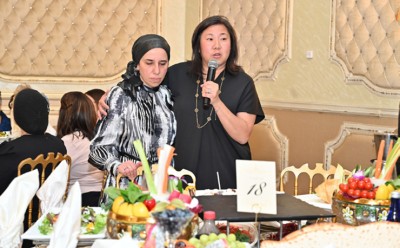
When the Nisanovs suddenly needed help themselves, years of relationships came rushing back toward them. Before family members traveled for the kevurah, one person placed $10,000 in Yonah’s hands and said simply, “You’re going to need this.” Another family helped provide a burial place. In Florida, families stayed close to Racheli’s mother in the hospital and made certain the family was fed and cared for. Eli understood that response as the kehillah returning a measure of the chesed his parents had spent decades giving others. U.S. Rep. Grace Meng was among those who later joined the memorial gathering, standing beside Rebbetzin Ora Nisanov as relatives, Rabbanim, friends and community members paid tribute to Racheli.
Rabbi Nisanov later put the bond between himself and the community into his own words when he said, “A king is not a king without his people, a rabbi is not a rabbi without his people around him.” The statement was less about status than about interdependence, and about a community that had learned over many years to show up for one another in both joy and pain.
Nine Yellow Lights And One White One
One memory from the hospital has remained especially vivid. Because traditional candles could not be lit there, the family used electric candles instead and happened to gather ten at random. When they were turned on, nine glowed yellow while one glowed white. No one had deliberately chosen the different light, but the contrast immediately caught the family’s attention, and Eli remembers thinking of his sister.
“Racheli is always going to be our light,” he said. The image stayed with the family not because anyone claimed to understand why the candles happened to look that way, but because in a hospital room filled with fear and grief, one small light looked unmistakably different from the others.
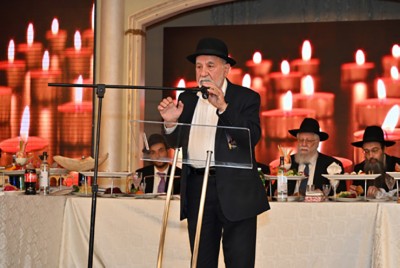
The memorial held another moment that required little explanation. Racheli’s grandfather, Amnon, rose to speak and tried to address the gathering in more than one language so different generations could understand him. But grief repeatedly interrupted whatever he had hoped to say. “I lost a granddaughter,” he managed before emotion overtook him, and at moments he simply could not continue. Some speeches remain with people because of their eloquence; this one remained because a grandfather did not have enough words for what had happened.
Carrying Her Memory Through Tefillah And Torah
No one at the memorial pretended to have an answer for why a 13-year-old girl had been taken from them. Several speakers said plainly that they still did not understand, and the evening did not try to force a neat explanation onto something the family continued to experience as profoundly painful.
One of the clearest ways they chose to carry her memory forward was through tefillah. Her siblings described prayer as something especially precious to Racheli. Nissan prepared a kuntres centered on Birkhot HaShachar, with Aviva—whom he described as a co-author and central to the production—helping bring the project together. The volume includes explanations intended to help readers slow down and think about words that are so easily recited by habit, along with memories from Racheli’s teachers, friends and siblings about her connection to tefillah.
Copies were placed on tables at the memorial for guests to take home. Nissan urged people not simply to read about his sister and put the booklet aside. Choose one brachah, he suggested. Learn its meaning, think before saying it, and allow an ordinary part of the morning to become a real moment of connection with Hashem.
His message was not simply to do something “for Racheli.” “Do it for yourself,” he told those gathered, explaining that grief can leave the heart unusually open and that the question is what a person chooses to place into that opening before ordinary life closes around it again.
One of his brothers had experienced that in his own learning. When memories of Racheli brought him to tears, he sometimes decided that the next day in yeshivah would be different. He would learn harder, take on another mitzvah or bring greater focus to his avodat Hashem. The tears remained, but he tried to turn them into another day of learning and growth.
Her brothers also completed Mishnayot l’ilui nishmat Rachel Aliza, turning a year marked by grief into sustained Torah learning in their sister’s memory. The evening ultimately concluded with that siyum and Kaddish, bringing the family back to a place associated with the earliest days of mourning but ending this time with Torah and a determination to continue.
A Father Facing The Calendar
At the center of the room were two parents living through a reality they never expected to know. Rabbi Nisanov stood before the gathering and confronted the calendar aloud: in less than a month, his daughter would have turned 15. “It’s very difficult to stand here,” he said, giving voice to the cruel arithmetic that forces bereaved parents to calculate the ages their children should have reached.
Parents expect to plan birthdays, watch children change from year to year and worry about the ordinary challenges of raising a teenager. They do not expect to mark those milestones in the conditional tense, measuring time by what should have happened.
Rabbi Nisanov then offered a distinction that has shaped how he has tried to live since Racheli’s death. “Pain is a reality. Suffering is a choice,” he said, immediately making clear that he was not suggesting grief can simply be turned off. “I cannot live the same way. I am not the same person.” Neither, he said, are his wife, their children or their parents. The loss changed them, and pretending otherwise would deny what the family had lived through.
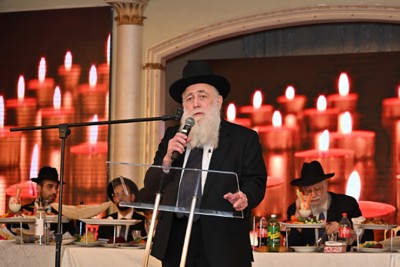
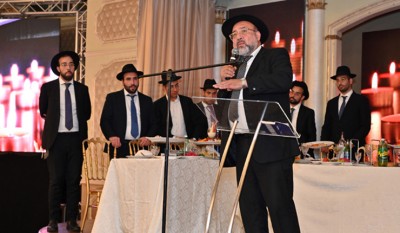
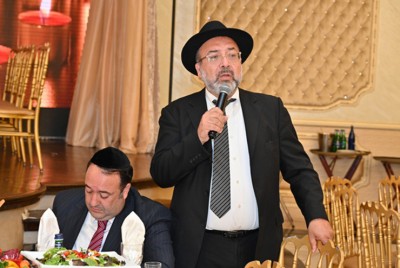
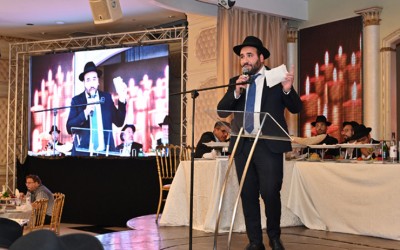
Rabbi Nisanov addresses the gathering during the one-year memorial for his daughter, speaking about loss, faith, family and continuing to live while carrying the pain of her absence.
He also reflected on the strange absence in language itself. A child who loses parents is called an orphan and a person who loses a spouse becomes a widow or widower, but there is no commonly used word for a parent who buries a child. “You don’t need a name,” he said. “You don’t need to be reminded. We remember very
At Racheli’s levayah, Rabbi Nisanov had expressed his faith and grief in one sentence his children still repeat: “I took her out of the water, and I gave her back to Hashem.” The sentence does not make a father’s anguish smaller. It reveals the impossible place where love for a child and faith in Hashem met for him in the same moment.
His tenderness as a father surfaced again as he spoke about the affectionate words he would always say to his daughter and would continue saying to his grandchildren. They were private family expressions that needed little translation. The love remained exactly where it had always been; the daughter he wanted to say those words to was no longer there to hear them.
Yet even in a speech shaped by loss, the ordinary grandfather in him remained unmistakable. He spoke about his grandchildren waking him up and joked about how children do not let parents sleep and grandchildren eventually do the same, before quietly calling it “the greatest feeling.” It was a small sentence, but perhaps one of the clearest signs of what he meant by continuing to live rather than allowing grief to end the rest of life.
Before ending, Rabbi Nisanov made another request of his community. He wanted people to keep calling him, but not only when something was wrong. “Please don’t call me just for yeshuah,” he said. “Call me for weddings also.” After a year defined by the worst call a father could receive, he was still asking to be invited into other people’s happiness.
“Build Your Children With Words Of Love”
During the shiv’ah and throughout the year, Rebbetzin Nisanov carried her own message to parents. Ely Zvi remembered women coming to comfort his mother and instead hearing her implore them to go home and love their children openly. Hug them, kiss them and do not assume they already know.
“Tell them explicitly, ‘I love you with all my heart,’” Ely Zvi recalled his mother saying. “Build your children with words of love. Don’t destroy them with words of anger.” Those words did not come from a parenting seminar. They came from a mother who would have given anything for another opportunity to hold her daughter, and everyone hearing them understood where that plea came from.
The message also fit the Racheli her siblings had spent the evening describing. She did not need dramatic gestures to make another person feel cared for. She bought a friend a present, came to babysit, washed dishes, picked up toys, prayed with feeling and helped without first asking what would come back to her.
Rabbi Nisanov similarly urged those gathered not to waste a short life consumed by other people’s faults. Everyone has shortcomings, he said, and nobody is perfect. There is too little time to remain trapped in grievances. “You die once,” he said. “You live every day.”
The calendar now carries one more painful reminder of that truth. Rachel Aliza should have been turning 15. She should have continued growing, changing, laughing with friends and gradually becoming the young woman her family assumed they would have years to know. There should have been more birthdays, more photographs, more evenings at home, more babysitting, more gifts for friends and more tefillot. Her family grieves not only for the 13-year-old girl they lost, but for every chapter of Rachel Aliza’s life they will never have the privilege of seeing.
Yet the memorial made something equally clear: they remember the girl they did have. Her friends remember the gifts. Yonah remembers coming home to children cared for and a house unexpectedly clean. Nissan remembers a sister whose face still appears to him in his own children. Her teachers remembered her tefillah. Her grandfather remembers her so painfully that a year later he struggles to finish a sentence, and her parents remember everything.
The evening concluded with the siyum Mishnayot completed l’ilui nishmat Rachel Aliza. Kaddish was recited, and around the room people answered Amen before collecting the kuntresim, saying their goodbyes and eventually returning home. Nothing that happened that evening could change the hardest fact of all: Rachel Aliza was still gone, and there remained an empty place within her family that no memorial, speech, siyum or passing year could fill. Yet for several hours, those who loved her had spoken far less about how Racheli died than about the ordinary things that revealed how she lived.
At the beginning of the evening, Rachel Aliza was there in a photograph, 13 years old and smiling, forever held at an age her family has already been forced to outlive. By the end of the night, the photograph was no longer carrying the memory alone. Racheli had been there in Yonah’s recollection of coming home to children cared for and dishes unexpectedly washed, in Nissan’s terrified plea not to be told which sister had died, in the one white hospital light among nine yellow ones, in a grandfather who struggled to finish a sentence, and in a mother’s plea to other parents to go home and tell their children explicitly that they are loved.
Nothing could bring Rachel Aliza Nisanov back, and everyone in the room understood that painful truth. But somewhere between the stories, the Torah, the tears and the Amen after Kaddish, the smiling girl in the memorial photograph became something more than an image again. For a few precious moments, the people who had known her were not simply remembering a tragedy. They were remembering Racheli, and for those moments, she was back in the room.
By Shabsie Saphirstein
Photo Courtesy Michael Kaykov @ Kaykov Media
For A Few Moments, Racheli Was Back In The Room
Typography
- Smaller Small Medium Big Bigger
- Default Helvetica Segoe Georgia Times
- Reading Mode