


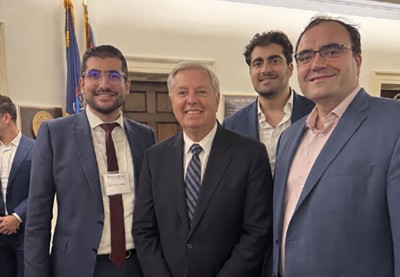
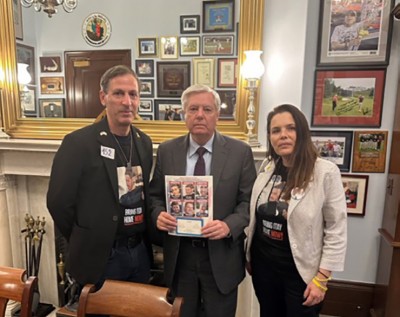
The public record already tells much of Senator Lindsey Graham’s story: decades of support for Israel, the Taylor Force Act, repeated visits to the Jewish state, military assistance, and a consistent defense of the U.S.-Israel alliance.
Since Graham’s passing, however, rabbis, hostage families, Israeli leaders, communal figures, and close friends have shared firsthand accounts that reveal what those relationships looked like away from Senate speeches and committee hearings.
During a July 21 tribute organized by the Israeli-American Council, Rabbi Yossi Refson of Chabad of Charleston recalled hosting Graham for breakfast in October 2018 when the senator received a phone call from President Donald Trump.
Graham used the conversation to urge Trump to recognize Israeli sovereignty over the Golan Heights. Pointing toward a Hebrew Bible in the room, Graham told the president that the land belonged to the Jewish people.
“A lone senator inspired by the Bible,” Rabbi Refson later said.
Months later, Trump formally recognized Israeli sovereignty over the Golan Heights.
The setting gave the story particular weight. Graham was not delivering a prepared speech before a pro-Israel audience. He was sitting at Chabad, with a Hebrew Bible nearby, making his case directly to the president.
Hostage families who came to know Graham after October 7 described the same personal involvement.
Orna Neutra, whose son Omer was killed during Hamas’ attack and whose remains were held in Gaza for more than two years, recalled that Graham made himself available whenever families traveled to Washington. He listened, asked questions, and told them what he believed rather than offering assurances he could not support.
“He offered no false hope,” she said.
During one meeting, Graham looked around at the assembled families and told them, “I wish you were all my constituents. I wish you were all from South Carolina.”
The remark reflected his desire to have greater ability to advocate for every family before him.
Ruby Chen, father of American-Israeli hostage Itay Chen, recalled a similar commitment. During their first meeting in October 2023, Graham promised always to tell him the truth about negotiations, even when the news was difficult. According to Chen, Graham kept that promise.
While Itay remained in Hamas captivity, Graham invited Chen to the 2024 State of the Union Address as his only official guest. The invitation placed a hostage father before the nation’s political leadership during one of Washington’s most visible annual events and helped keep the hostage crisis before the American public.
Prime Minister Benjamin Netanyahu recalled Graham’s determined approach toward American assistance for Israel.
Netanyahu said Graham sometimes argued that Israel was not receiving enough. When the prime minister replied that the existing level of support was sufficient, Graham reportedly answered, “No, I’m going to up it and don’t interfere.”
Graham viewed American support for Israel not as charity, but as an investment in the security of both countries.
Netanyahu said the two spoke only days before Graham’s death about the remaining Iranian threat and broader regional peace, including the possibility of expanding the Abraham Accords.
Recordings captured by documentary filmmaker Alex Holder provide an unusually candid view of how their relationship worked behind closed doors.
Holder spent several years following Graham for the forthcoming documentary Lindsey’s Game. In one recording, Graham was preparing to travel to Florida to encourage President Trump to support an Israeli operation against Hezbollah.
Netanyahu urged caution, warning that opening another major front while Israel remained focused on Iran could provoke a wider Hezbollah response.
“That’s actually good counsel,” Graham replied.
The exchange showed a side of Graham less visible in his public rhetoric. One of Washington’s most outspoken foreign-policy hawks could press Israel toward stronger action, yet reconsider when Israel’s prime minister believed restraint better served the country’s security.
Another recording captured the relationship working in the opposite direction.
In an October 2024 telephone conversation recorded by Holder, Graham advised Netanyahu on building bipartisan Senate opposition to the International Criminal Court’s pursuit of Israeli leaders.
Graham encouraged Netanyahu to contact Democratic Senators Ben Cardin and Richard Blumenthal, describing them as fair-minded toward Israel and urging the prime minister to bring them into the effort challenging the ICC prosecutor’s actions. He then joked that Netanyahu should pay him in shekels for the advice.
Cardin and Blumenthal subsequently joined Graham and other senators in questioning the ICC’s handling of the cases involving Netanyahu and then-Defense Minister Yoav Gallant and calling for scrutiny of allegations concerning ICC Prosecutor Karim Khan. Both Democrats had already joined bipartisan opposition to the ICC’s actions against Israel earlier that year.
The recording offered a rare look at Graham’s work away from the cameras. He was advising Israel’s prime minister about which Democratic senators to approach, identifying potential allies, and working to build bipartisan support inside the Senate.
The two recordings also show the give-and-take of Graham’s relationship with Netanyahu. Netanyahu could tell Graham to slow down when he believed military escalation was unwise. Graham could tell Netanyahu which senators to call when Israel needed bipartisan support in Washington.
Holder also described Graham’s unusual access throughout the region. During the years he followed him, Graham spoke with Netanyahu, Trump, Saudi Crown Prince Mohammed bin Salman, and senior military officials on regional security. Holder said Graham was received in Israel more like a head of state than an ordinary visiting senator.
Betsy Berns Korn, chair of the Conference of Presidents of Major American Jewish Organizations and a former AIPAC president, witnessed that access from another perspective. She recalled repeatedly arriving for meetings with senior Israeli officials only to discover that Graham and his staff had already been there.
“He was present,” Korn said. “He was engaged.”
By the time others entered the room, Graham had often absorbed the briefings, asked questions, and begun considering what could be done next.
Dr. Miriam Adelson offered another glimpse into Graham’s private relationships. She recalled that her late husband, Sheldon Adelson, spoke with Graham so frequently that hardly a day passed without a conversation between the two men. They discussed Israel, American politics, and the challenges facing the Jewish state.
She also remembered Graham visiting the Las Vegas Sands with Senator John McCain. McCain entered a VIP room to gamble. Graham, who had little interest in gambling, spent his time meeting visitors.
“Instead of playing, he was meeting people,” she recalled.
Rabbi Levi Shemtov, executive vice president of American Friends of Lubavitch, recalled veteran Washington attorney Norm Brownstein repeatedly describing Graham’s friendship with the Jewish people as genuine and demonstrated through action rather than words.
Former Senator Norm Coleman, now national chairman of the Republican Jewish Coalition, remembered Graham expressing the relationship more simply: “We are family.”
The Republican Jewish Coalition has since announced that it will establish an annual Lindsey Graham Statesman Award and dedicate its next leadership summit to his memory.
Taken together, the accounts show how Graham’s public support for Israel translated into private action. At a Chabad breakfast, he used an unexpected call from the president to argue Israel’s case. With hostage families, he offered honesty rather than promises and used his sole State of the Union invitation to give one father a national platform. When Netanyahu said Israel had enough American support, Graham wanted to provide more. When Netanyahu advised restraint on Hezbollah, Graham listened. When Israel faced the ICC, Graham advised its prime minister on how to build bipartisan support in Washington.
Then there were the quieter moments: daily conversations with Sheldon Adelson, arriving ahead of Jewish leaders for meetings in Israel, choosing to meet people while McCain gambled, and telling members of the Jewish community that they were family.
These accounts do not change the historical record of Lindsey Graham’s support for Israel. They show the personal commitment behind it.
Those who knew Graham remember not only legislation and speeches, but conversations held away from cameras, promises made to grieving parents, and relationships maintained over years. He could argue forcefully, listen when challenged, change course when persuaded, and pick up the phone to bring someone else into the effort.
For Lindsey Graham, friendship with Israel and the Jewish community was not something to declare from a podium. It was something to practice.
By Shabsie Saphirstein
New Stories Reveal Lindsey Graham’s Personal Bond With Israel And The Jewish Community
Typography
- Smaller Small Medium Big Bigger
- Default Helvetica Segoe Georgia Times
- Reading Mode