


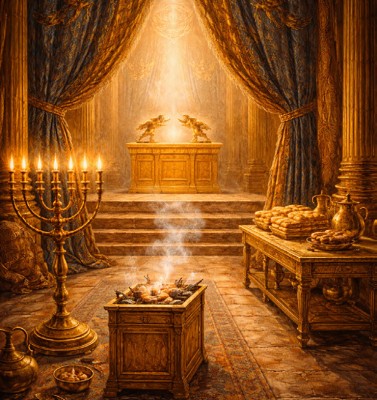
In Parashat Terumah, the Almighty instructs Moshe regarding the construction of the portable Tabernacle, the Mishkan — the place where the Divine Presence would dwell among Israel.
The Mishkan comprised three areas. Innermost was the Holy of Holies, where the Ark of the Covenant stood. Inside the Ark lay both sets of Tablets: the first, broken Tablets that Moshe shattered when he saw the Golden Calf, and the second set that he later brought down from Sinai. Alongside the Ark were sacred objects that preserved the memory of Israel’s wilderness journey — a vessel of mahn, the oil used to anoint kings of the House of David, and Aharon’s almond staff that had blossomed.
Only the Kohen Gadol was permitted to enter this innermost chamber, and only once a year, on Yom Kippur. Even then, he could enter only four times; a fifth entry was forbidden. This teaches how absolutely unique and unapproachable the presence of God was in that space.
The second chamber, the Kodesh (Sanctuary), contained three central vessels. To the north stood a golden table bearing twelve loaves of bread, arranged in two rows of six — symbolizing the twelve tribes of Israel sustained by Divine blessing. To the south stood the seven-branched Menorah, whose light represented Torah and wisdom. Between them stood the golden incense altar, upon which fragrant spices were burned twice daily.
The outer area was the Courtyard, which housed the large copper altar and the washbasin used by the Kohanim. This tripartite structure — Courtyard, Sanctuary, and Holy of Holies — later became the model for both the First and Second Temples, and for the future Third Temple.
The Almighty gave Moshe precise dimensions for every part of the Mishkan. Even its coverings carried meaning. The inner ceiling of multicolored woven cloth symbolized the Ten Commandments, while the outer covering of goat hair — divided into eleven sections — represented the five books of the Written Torah together with the six orders of the Oral Torah.
The walls were formed from forty-eight wooden planks — corresponding to the number of Prophets in Israel — teaching that the Mishkan was not only a physical structure, but a spiritual system rooted in prophecy and revelation.
This portable sanctuary became the prototype for the eternal House of G-d in Jerusalem.
King David longed to build that House. He studied its design with awe, gathered materials, purchased the sacred site on Har HaMoriah, and prepared detailed plans under prophetic guidance. Yet God did not permit him to build it, because his reign — though righteous and necessary — had been marked by war and bloodshed.
Instead, the Temple was built by his son Shlomo, in a time of peace. The First Temple stood for 410 years; after a seventy-year exile, the Second Temple was built and stood for 420 years.
Tradition teaches that the site of the altar in Jerusalem was not chosen at random. It was the very place where Adam offered the first sacrifice, where Kayin and Hevel brought their offerings, where Noach built an altar after the Flood, and where Avraham bound Yitzchak. Thus, the Mishkan in the wilderness — and later the Temple — stood in direct continuity with humanity’s earliest encounters with G-d.
The Mishkan was therefore not merely a structure of wood, gold, and fabric. It was the meeting point of heaven and earth, past and future, law and compassion — a place where Israel learned that holiness can dwell in the world.
By Rabbi Yitzchak Zilber, zt”l
Parashat Terumah — The Dwelling Place Of Holiness
Typography
- Smaller Small Medium Big Bigger
- Default Helvetica Segoe Georgia Times
- Reading Mode