


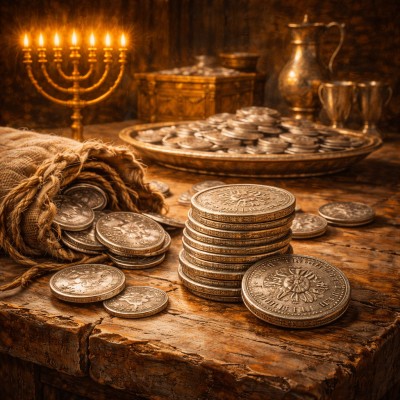
Parashat Ki Tisa opens with a seemingly technical commandment: every Jewish man, beginning at the age of twenty, was required to contribute exactly one half-shekel toward the communal service of the Mishkan. The Torah emphasizes that the rich could not give more and the poor could not give less. Every Jew gave the same amount.
At first glance, this appears to be merely a financial system designed to fund the Temple. Yet Rabbi Yitzchok Zilber explains that the half-shekel reveals one of the deepest foundations of Jewish survival — a lesson that becomes especially clear during the month of Adar and the story of Purim.
The Torah calls this contribution a terumah, a donation that elevates both the object given and the person who gives it. Unlike ordinary charity, the half-shekel was not about generosity or status. No donor could claim distinction. Wealth created no advantage; poverty created no exclusion. Every Jew stood equal before the sacred mission of sustaining the nation’s spiritual center.
This equality was deliberate. The Mishkan did not belong to leaders or benefactors; it belonged to the entire people. Even King David followed this principle generations later when purchasing the future site of the Beit HaMikdash. Rather than paying from the royal treasury, he divided the cost among the twelve tribes so that every Jew would possess a share in the holiest place on earth.
Why specifically a half-coin?
Rabbi Shlomo HaLevi Alkabetz explains that no individual Jew is complete alone. A single person cannot fulfill all mitzvot. Only together does Klal Yisrael become whole. Each Jew represents only half; unity creates completeness.
This idea stands at the heart of Purim.
Haman’s accusation before Achashverosh was not merely political. He described the Jews as “a scattered and divided people.” Jewish disunity was the spiritual opening that allowed danger to arise. The response to that threat was not military strength but national unity — fasting together, praying together, and accepting responsibility for one another.
The custom practiced before Purim of giving three half-coins recalls the Temple half-shekel and reinforces this message annually. Redemption came not through individual merit alone but through collective identity.
Rabbi Zilber noted that the Torah established extraordinary safeguards to prevent even suspicion of financial misconduct when Temple funds were collected. The official removing coins from the treasury wore garments without pockets, without lining, and even without shoes. He spoke continuously while handling the money so no one could suspect wrongdoing.
Why such extreme precautions for a trusted individual?
Because communal trust is sacred. Jewish continuity depends not only on holiness but on integrity that withstands scrutiny. Once suspicion enters public life, unity fractures — and history shows the consequences can be severe.
The half-shekel therefore taught two parallel lessons: equality and accountability. Every Jew matters equally, and every communal responsibility must be handled transparently.
Purim reflects this same balance. The salvation described in Megillat Esther did not erase differences among Jews; rather, it unified them toward a shared destiny. The mitzvos of the day — gifts to the poor, sending portions of food, and communal celebration — rebuild social bonds and remind us that no Jew stands alone.
A full coin symbolizes independence. A half-coin teaches dependence upon one another.
Rabbi Zilber emphasized that Jewish history repeatedly demonstrates this truth. Whenever Jews saw themselves merely as individuals, vulnerable divisions appeared. When they understood themselves as parts of a single whole, survival and blessing followed.
Thus, the commandment of the half-shekel is not only about funding a sanctuary long ago. It is a timeless reminder that holiness emerges from shared responsibility.
Purim arrives each year to teach the same lesson anew: redemption begins when separate halves become one people.
Rabbi Yitzchok Zilber, zt”l, dedicated his life to teaching Torah, and his impactful writings continue to inspire Jews worldwide. Copyright 2023 by The LaMaalot Foundation. Conversations on the Torah is catalogued at The Library of Congress. All rights reserved. www.LaMaalot.org
Half A Coin, One Nation: The Hidden Purim Message Of Parashat Ki Tisa
Typography
- Smaller Small Medium Big Bigger
- Default Helvetica Segoe Georgia Times
- Reading Mode