

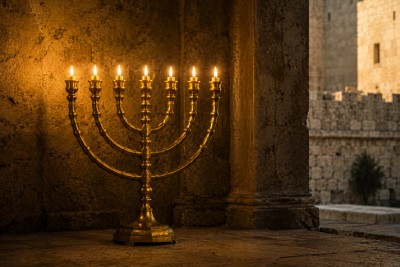
The opening of Parashat Beha’alotcha returns to a subject already discussed earlier in the Torah: the lighting of the Menorah in the Mishkan. At first glance, this seems repetitive. The Menorah and its laws were already described in Parashat Tetzaveh. Why revisit it now?
The Midrash explains that Aharon HaKohein felt pain during the dedication of the Mishkan. The leaders of every tribe brought offerings and participated publicly in the inauguration, while the tribe of Levi appeared absent from the celebration. Aharon feared this meant Heaven did not consider him worthy enough to take part.
Hashem responded with reassurance. Moshe was instructed to tell Aharon that his role was greater than all the gifts and sacrifices brought by the tribes. Their offerings would one day end when the Temple would no longer stand. But the light of the Menorah and the blessings of the Kohanim would endure forever.
This promise became one of the most remarkable realities in Jewish history.
More than 2,000 years ago, the Greeks conquered Eretz Yisrael and launched a campaign against Torah life. Shabbat observance, circumcision, and kashrut were outlawed. Torah scholars were humiliated publicly. Jews were pressured to abandon their identity in favor of Greek culture and philosophy.
What made the danger even greater was that the attack came not only from outside enemies, but from within Jewish society itself. Many Jews had become attracted to Hellenism and viewed Torah as outdated. The Beit HaMikdash was desecrated. Idols stood where holiness once filled the world.
To many observers, traditional Judaism appeared finished.
Then came a small group of faithful Jews led by Matisyahu Chashmona’i and his sons. They were not the strongest army. They did not possess political influence or military superiority. Yet they carried something stronger: conviction that the Torah was eternal.
Against every logical expectation, they defeated the Greek empire and purified the Beit HaMikdash. When they searched for pure oil to relight the Menorah, they found only enough for one day. Yet the flame burned for eight.
The miracle was not merely about oil. It was about continuity.
Empires that once dominated the world disappeared. The Greeks, Romans, and countless other civilizations faded into history. Yet the candles first lit by the Chashmona’im still burn in Jewish homes every year during Chanukah.
Rabbi Yosef Yitzchak Schneerson ob"m once pointed to this idea as proof that no Jew should ever despair. A person may feel distant from Judaism. Entire generations may have grown up disconnected from Torah. Yet the spark can still reignite.
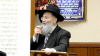
Rabbi Zilber often saw this personally among Jews raised under Soviet Communism. Families whose parents and grandparents had lived without Torah suddenly began rediscovering mitzvot, learning Hebrew, lighting candles, and returning to Jewish life. What appeared extinguished was only hidden beneath the surface.
The Menorah teaches that holiness can survive even the darkest periods.
The flames of the Temple represented more than physical light. They symbolized the eternal light of Torah itself — a light that survives oppression, exile, persecution, and spiritual confusion.
Other lights throughout history have burned brightly for a moment and disappeared. The Menorah continues to shine.
Parashat Beha’alotcha is sponsored by Yair (Yuriy) & Roza Sadykov.
Rabbi Yitzchok Zilber, zt”l, dedicated his life to teaching Torah, and his impactful writings continue to inspire Jews worldwide. Copyright 2023 by The LaMaalot Foundation. Conversations on the Torah is catalogued at The Library of Congress. All rights reserved. www.LaMaalot.org
Parashat Beha’alotcha: The Light That Never Went Out
Typography
- Smaller Small Medium Big Bigger
- Default Helvetica Segoe Georgia Times
- Reading Mode