


When congregants arrived at Young Israel of Holliswood and Young Israel of Jamaica Estates, they were met with a heartbreaking sight. Human feces and motor oil had been hurled at the entrances to their synagogues in what police are investigating as antisemitic acts of vandalism.
For many communities, moments like these create fear. In Queens, they created something else: unity.
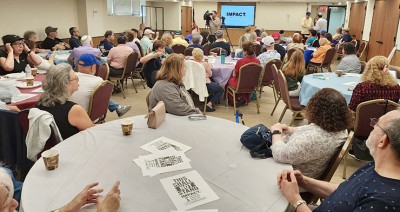
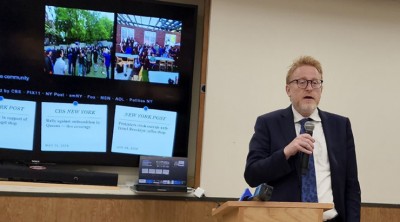
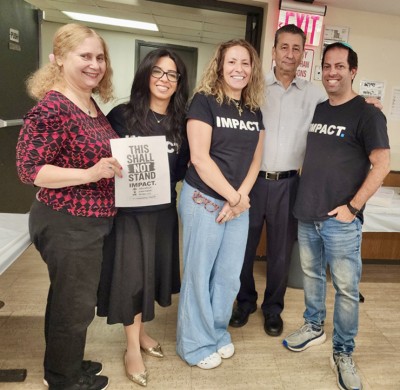
Just days after the attacks, rabbis, synagogue leaders, parents, and community members from across the borough gathered locally for an IMPACT advocacy training. Hosted in partnership with area congregations—including local community centers and regional clubs—the program was designed to do more than discuss antisemitism. It was created to prepare the community to respond together.
Building a Stronger Community
The gathering was months in the making. Community leaders Ira Chazan and William Maiman had been working to bring together synagogues that often shared the same concerns but rarely had an opportunity to collaborate in a coordinated way.
"We saw a chance to bring other synagogues into the effort," Chazan said. "Now we have a foundation to build upon."
That foundation is exactly where IMPACT comes in. IMPACT is a nonprofit dedicated to organizing, empowering, and mobilizing the Jewish community and its allies to combat antisemitism, stand with the people of Israel, and amplify Jewish joy, resilience, and pride. Rather than replacing existing Jewish organizations, IMPACT seeks to strengthen them by connecting synagogues, schools, nonprofits, students, and community leaders into one coordinated network.
The philosophy is simple: Communities that are connected before a crisis respond better during one.
From Anxiety to Agency
Local rabbinic leadership opened the morning by acknowledging what many in the room had been feeling.
"There are plenty of sources of anxiety," leadership noted. "But we do have agency. We do have the capacity to make a difference."
Those words became the theme of the day, shifting the mindset from "What can someone do?" to "What can I do?"
Participants learned practical advocacy skills, including how to engage elected officials, respond to antisemitism on social media, tell compelling stories, build partnerships with allies, and organize local action when incidents occur. The goal wasn't simply to react; it was to prepare.
The Power of Working Together
William Maiman, of the community, believes that collaboration is essential.
"Here in Queens, we see the ugly rise of antisemitism," he said. "This initiative is about unifying people and leading to more effective communication and positive action."
Looking around the room, Chazan saw the same momentum. "People are fed up with what's going on and are ready to take action."
That may have been the greatest success of the morning: synagogues that had often worked independently were now sitting side by side, sharing ideas, building relationships, and creating a stronger network for the future.
Responding with Jewish Pride
Perhaps the most emotional remarks came from Rabbi Moshe Taub of Young Israel of Holliswood, whose synagogue had been targeted. Rather than speaking with anger, he spoke with determination.
"We have to continue to come to shul, continue to pray, wear your Magen David, wear your yarmulke, and keep your head held high."
Rabbi Taub also reminded the audience that combating antisemitism requires allies. "We cannot survive without the help of our non-Jewish neighbors."
His message reflected one of IMPACT's core values: building bridges with communities of every faith who believe that hatred against one community threatens everyone.
A Model for the Future
Antisemitism is not disappearing overnight, but Queens demonstrated something powerful this week: when synagogues unite, when community leaders collaborate, and when people are equipped with practical tools instead of frustration, hope replaces helplessness.
At the close of the program, Rabbi Taub offered IMPACT a memorable blessing, praying that one day the organization would no longer be needed because there would be nothing left to protest.
Until that day comes, the work continues, because the strongest answer to organized hate is an organized community.
To learn more about IMPACT and join the movement to organize, empower, and mobilize communities to combat antisemitism, follow @joinimpactnow on social media or visit www.joinimpact.app
Aaron Herman is a nonprofit fundraiser, video journalist, and growth strategist specializing in Jewish storytelling and advocacy. He is Co-Founder and CEO of IMPACT. His reporting has appeared in national and Jewish media outlets. Aaron holds a BA from Binghamton University and an MPA from NYU's Wagner School and can be reached at This email address is being protected from spambots. You need JavaScript enabled to view it..
From Fear to Action: How Queens Synagogues United to Build a Stronger Jewish Community
Typography
- Smaller Small Medium Big Bigger
- Default Helvetica Segoe Georgia Times
- Reading Mode